SUGGESTED URL SLUG: florida-homeowner-12-month-home-maintenance-calendar-region-by-region
SEO TITLE: Florida Homeowner's 12-Month Home Maintenance Calendar
META DESCRIPTION: The Florida Homeowner's 12-Month Home Maintenance Calendar, broken down by region. Protect your home year-round with this Florida-specific seasonal guide.
The Florida Homeowner's 12-Month Home Maintenance Calendar (Region-by-Region)
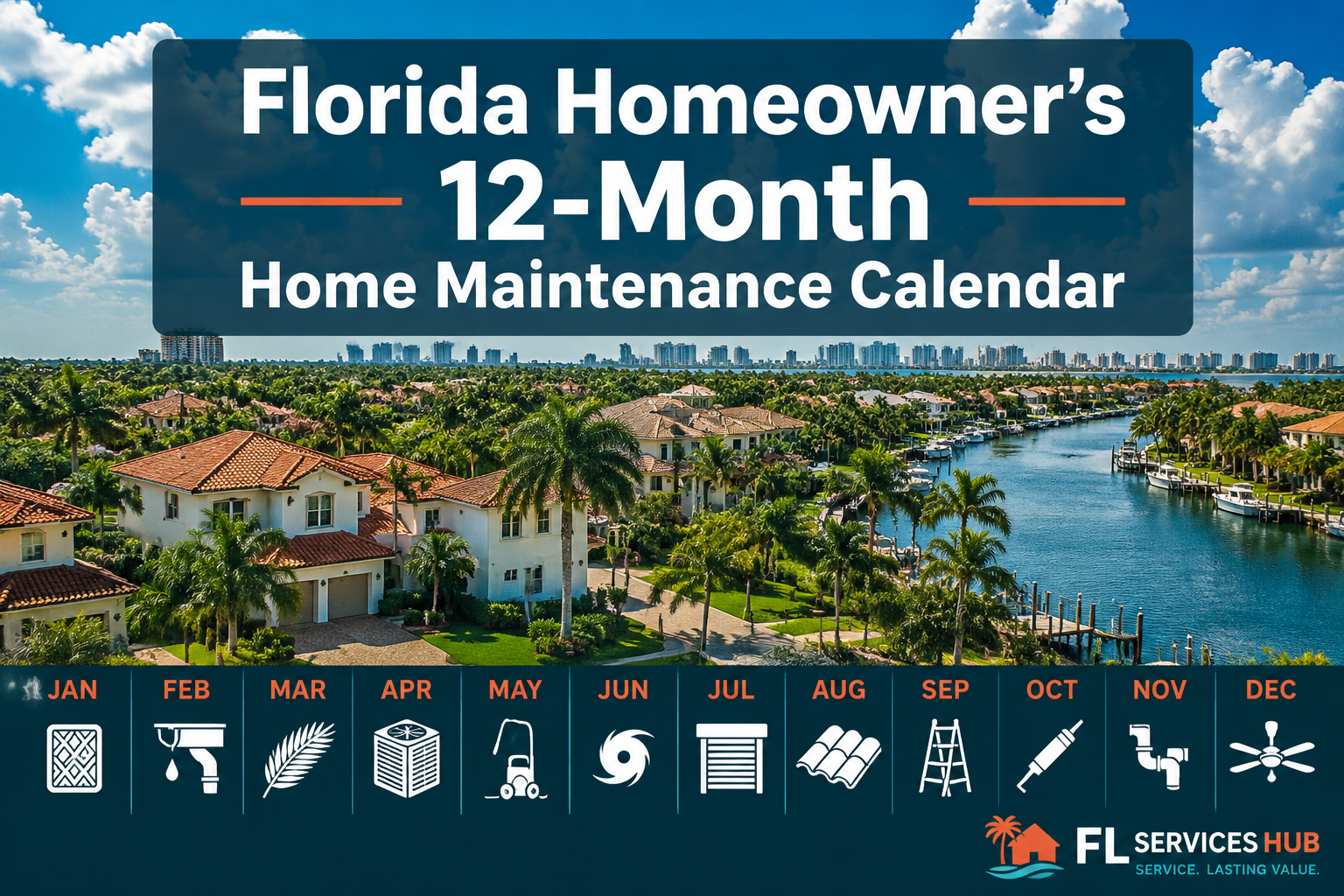
Updated May 2026 | Florida-specific | Reviewed by licensed contractors in our network
Florida homeowners file more weather-related insurance claims per capita than any other state in the country — and the majority of those claims involve damage that a routine maintenance task could have prevented or significantly reduced. A missed roof inspection in March costs far more than the inspection itself when a June storm finds the gap first.
Deferred maintenance in Florida doesn't just degrade your home slowly. It accelerates. Salt air in Naples and Fort Lauderdale corrodes faster than inland conditions. The humidity in Orlando and Jacksonville feeds mold inside wall cavities within weeks. And when hurricane season arrives — June through November — every skipped task becomes a potential claim, a rate increase, or a denied coverage event. Homeowners who lack documented maintenance records increasingly find insurers pushing back on claims, citing "wear and tear" exclusions that a simple service receipt would have countered.
At FL Services Hub, our network spans verified, licensed, and insured contractors across Tampa, Miami, Orlando, Jacksonville, Fort Lauderdale, and Naples. We work with hundreds of Florida homeowners every year and hear the same story: the problem wasn't the storm, the leak, or the AC failure — it was the six months of ignored warning signs before it.
This guide gives you a practical, month-by-month framework built specifically for Florida's climate, insurance environment, and regional differences. Here's exactly what you'll get:
- A month-by-month maintenance checklist covering all 12 months, not just hurricane prep
- Region-specific breakdowns for South Florida, Central Florida, and North Florida — because Naples and Jacksonville are not the same climate
- Real cost ranges for the most common seasonal services in Tampa, Miami, Orlando, and beyond
- Insurance-relevant tasks that protect your coverage, not just your home
- Red flags to watch for when hiring seasonal contractors
- A booking timeline so you're never scrambling for a pro during peak demand
If you'd rather skip the research and compare quotes from verified Florida contractors in your city, you can do that in about 60 seconds — no obligation. Get free quotes from trusted Florida pros →
What's in this guide:
- Why Florida Home Maintenance Is a Different Animal
- The Florida Homeowner's 12-Month Home Maintenance Calendar (Region-by-Region): Full Monthly Breakdown
- Regional Differences: South Florida vs. Central Florida vs. North Florida
- Cost Breakdown by Florida City
- What Florida Insurance Carriers Actually Expect
- Red Flags When Hiring Seasonal Contractors in Florida
- The Booking Timeline: When to Schedule What
- Frequently Asked Questions
- How to Get Verified Quotes Through FL Services Hub
The calendar starts in January — but the best time to begin is whatever month you're reading this.
Why Florida Home Maintenance Is a Different Animal
Florida doesn't have four seasons. It has two: a wet season (roughly May through October) and a dry season (November through April). That distinction reshapes every maintenance priority on the calendar.
The wet season brings heat, humidity, tropical storms, and hurricane risk. The dry season brings cooler temperatures, reduced rainfall, and the window most Florida homeowners have to complete exterior repairs, landscaping overhauls, and roof work before the cycle starts again.
What makes Florida uniquely demanding isn't just the weather — it's the combination of factors hitting simultaneously:
- Humidity levels averaging 70–90% in summer accelerate mold, wood rot, and pest infiltration
- Salt air in coastal markets like Miami, Naples, and Sarasota corrodes metal components, HVAC coils, and roofing fasteners faster than inland areas
- UV intensity in South Florida degrades exterior paint, caulk, and roofing materials at roughly twice the rate of northern states
- Hurricane season (June 1 – November 30) creates a hard deadline for any structural, roofing, or window maintenance
- Florida's insurance market — among the most volatile in the country — increasingly ties coverage eligibility and renewal rates to documented maintenance history
Skipping one year of maintenance in Florida isn't like skipping a year in Ohio. The compounding effect of heat, moisture, and biological growth means a $300 gutter cleaning skipped in March can turn into a $4,000 fascia repair by August.
The Florida Homeowner's 12-Month Home Maintenance Calendar (Region-by-Region) exists because a generic national checklist won't cut it here. The tasks, the timing, and the stakes are different.
The Florida Homeowner's 12-Month Home Maintenance Calendar (Region-by-Region): Full Monthly Breakdown
Use this as your master reference. Regional variations are noted where timing or priority differs between South Florida, Central Florida, and North Florida.
🗓 January — Dry Season Deep Work
Best month for exterior projects. Temperatures are mild, contractor availability is higher, and you have five months before hurricane season.
- Inspect roof for cracked, missing, or lifted shingles — schedule a professional inspection if the roof is 7+ years old
- Clean and flush gutters and downspouts
- Check exterior caulking around windows, doors, and penetrations
- Service your HVAC system (filter replacement, coil cleaning, refrigerant check) — see the Tampa AC tune-up cost guide for what to expect
- Inspect attic insulation and ventilation
- North Florida note: January brings the occasional freeze. Wrap exposed pipes and check irrigation backflow preventers.
🗓 February — Pest Control Window
Termite swarm season begins in South Florida as early as February. This is the single most important pest control month for homeowners in Miami, Fort Lauderdale, and Naples.
- Schedule a professional termite inspection — Formosan and subterranean termites are active early in South Florida. The termite treatment cost guide for Miami breaks down what inspections and treatments actually cost
- Check for ant trails, rodent entry points, and cockroach activity near plumbing penetrations
- Inspect and clean dryer vents — a fire risk that's easy to overlook
- Test smoke and CO detectors; replace batteries
- Central Florida note: February is ideal for repainting exterior surfaces before summer UV exposure peaks
🗓 March — Pre-Hurricane Season Preparation Begins
You have roughly 90 days before the official start of hurricane season. Use March to assess structural vulnerabilities.
- Schedule a professional roof inspection — roofing contractors book fast as April approaches. Check roof replacement costs in Tampa if your inspection reveals issues
- Inspect hurricane shutters, impact windows, and garage doors for damage or operational issues
- Test whole-home generators; service if needed
- Trim trees and palms away from the roofline — overhanging branches are a major storm damage source
- Review your homeowner's insurance policy: confirm coverage limits, wind mitigation discounts, and any documentation requirements
🗓 April — Landscaping and Irrigation Overhaul
April is the last comfortable month for major landscaping work before summer heat makes outdoor labor brutal and plant stress increases.
- Service irrigation systems: check heads, adjust zones, test rain sensors
- Fertilize lawn (St. Augustine, Zoysia, and Bahia grass all have different schedules — confirm with a local pro)
- Plant heat-tolerant annuals and perennials before summer
- Check pool equipment: pump, filter, and chemical balance before swim season peaks
- Inspect fence posts and gate hardware for corrosion or wood rot
For lawn care pricing across Florida, the 2026 Florida lawn care cost guide gives you realistic benchmarks by region.
🗓 May — Final Pre-Season Lockdown
Hurricane season starts June 1. May is your last realistic window to complete any structural or exterior work.
- Confirm all roof repairs are complete and permitted
- Stock emergency supplies: generator fuel, water, flashlights, first aid
- Photograph your home's interior and exterior for insurance documentation
- Test sump pumps and French drains
- Verify that all exterior doors and windows are properly sealed
- South Florida note: Pool screen enclosures should be inspected for torn panels and loose framing before storm season
🗓 June — Hurricane Season Begins; Interior Focus
Exterior contractor availability drops. Shift focus to interior systems and monitoring.
- Check AC performance under full load — June is when systems fail under peak demand. See AC repair costs in Miami if you're dealing with a struggling unit
- Monitor for mold in bathrooms, laundry rooms, and attic spaces
- Inspect plumbing under sinks and around the water heater for slow leaks
- Clean pool filters and check chemical levels weekly as bather load increases
- Keep storm supplies accessible and generator tested
🗓 July — Moisture Management Month
Peak humidity. July is when mold problems that started in June become visible.
- Run bathroom exhaust fans consistently; check that they vent to the exterior (not into the attic)
- Inspect window seals for condensation between panes
- Check roof flashing around chimneys, skylights, and vents
- Clear storm drains and yard drainage paths before afternoon storms overwhelm them
- Jacksonville and North Florida note: July is peak thunderstorm season — check surge protectors and whole-home surge protection devices
🗓 August — Mid-Season Check
Peak of hurricane season statistically falls in August and September. Keep the home storm-ready while managing ongoing systems.
- Recheck hurricane shutters and impact window hardware
- Inspect exterior walls for paint bubbling, which signals moisture intrusion
- Check attic for signs of roof leaks after heavy rain events
- Service pool equipment — pumps work hardest in summer heat
- Verify generator fuel supply and test run
🗓 September — Storm Watch + Structural Monitoring
Statistically the most active hurricane month. Stay vigilant and document any storm damage immediately.
- After any named storm or significant rain event: walk the roof perimeter (from the ground) and inspect gutters for debris or displacement
- Document any water intrusion with photos and timestamps — critical for insurance claims
- Check exterior doors and garage door seals for wind-driven rain infiltration
- Coastal markets (Naples, Fort Lauderdale, Sarasota): Inspect seawall, dock hardware, and any marine-adjacent structures after storm activity
🗓 October — Post-Storm Assessment + Dry Season Prep
Hurricane season winds down. October is when smart homeowners get ahead of repair queues.
- Schedule post-storm roof inspection before contractor demand peaks in November
- Flush and service irrigation systems before dry season begins
- Clean gutters of summer debris buildup
- Inspect exterior paint and caulking for UV and moisture damage
- Begin planning any major projects (kitchen, bath, additions) for winter contractor availability
🗓 November — Exterior Refresh Window Opens
Dry season begins. Temperatures drop, humidity falls, and this is the best time to tackle exterior work.
- Repaint exterior surfaces — lower humidity means better adhesion and cure time
- Power wash driveways, walkways, and pool decks
- Reseal pavers if needed
- Schedule HVAC maintenance before the brief Florida "winter" sets in
- North Florida note: Prepare for frost events — cover sensitive plants, insulate outdoor pipes
🗓 December — Year-End Systems Check
Close the loop. December is for auditing what got done and scheduling what didn't.
- Test all smoke, CO, and security system devices
- Flush water heater sediment (especially in hard-water areas like Orlando and Tampa)
- Inspect electrical panel for signs of corrosion or overloaded breakers
- Review and file all maintenance receipts and inspection reports — your insurer may ask for them
- Schedule January appointments early — roofing and HVAC contractors book fast in the new year
Regional Differences: South Florida vs. Central Florida vs. North Florida
The Florida Homeowner's 12-Month Home Maintenance Calendar (Region-by-Region) isn't one-size-fits-all. These three climate zones demand different priorities.
| Task | South Florida (Miami, Naples, Fort Lauderdale) | Central Florida (Orlando, Tampa, Sarasota) | North Florida (Jacksonville, Tallahassee) |
|---|---|---|---|
| Termite inspections | February–March (Formosan swarms early) | March–April | April–May |
| Freeze prep | Rarely needed | Occasional (Dec–Feb) | Annual priority (Nov–Feb) |
| Hurricane shutter inspection | March and August | March and August | March (lower risk, still needed) |
| Salt air corrosion checks | Every 6 months | Coastal areas only | Minimal |
| Lawn fertilization schedule | Year-round (4–5 applications) | March–October | March–September |
| Roof UV degradation rate | High — inspect annually | Moderate — inspect every 18 months | Lower — inspect every 2 years |
| Mold risk window | Year-round | May–October | June–September |
Cost Breakdown by Florida City
Knowing what to do is half the equation. Knowing what it costs prevents sticker shock.
| Service | Tampa | Miami | Orlando | Jacksonville | Naples |
|---|---|---|---|---|---|
| Roof inspection | $150–$300 | $175–$350 | $150–$275 | $125–$250 | $175–$325 |
| HVAC tune-up | $85–$175 | $95–$195 | $80–$165 | $75–$150 | $100–$200 |
| Termite inspection | $75–$150 | $85–$175 | $75–$150 | $65–$135 | $90–$175 |
| Gutter cleaning | $100–$250 | $125–$275 | $95–$225 | $85–$200 | $125–$275 |
| Pool cleaning (monthly) | $100–$175 | $110–$190 | $95–$165 | $90–$155 | $115–$195 |
| Lawn care (monthly) | $120–$250 | $130–$275 | $110–$240 | $100–$220 | $135–$280 |
| Exterior repaint | $2,500–$5,500 | $3,000–$6,500 | $2,200–$5,000 | $2,000–$4,500 | $3,000–$6,000 |
Ranges reflect typical single-family homes (1,500–2,500 sq ft). Prices vary based on home size, access, and current material costs.
Want to compare prices for these services in your city? Get 3 free quotes from verified Florida contractors →
What Florida Insurance Carriers Actually Expect
Florida's property insurance market is under significant pressure, and carriers are scrutinizing maintenance records more carefully than they were five years ago.
Key documentation habits that protect your coverage:
- Keep receipts for every professional service — roof inspections, HVAC tune-ups, pest control treatments. A paper trail demonstrates proactive maintenance.
- Wind mitigation reports are critical in South Florida. A current wind mitigation inspection (typically $75–$150) can unlock meaningful discounts on your wind premium. Carriers want to see these updated after any roof work.
- Four-point inspections (roof, electrical, plumbing, HVAC) are required by many carriers for homes over 25 years old. Schedule these proactively — don't wait for a renewal notice.
- Documented storm response matters. If a hurricane passes and you file a claim, having timestamped photos taken before and after the storm strengthens your position significantly.
- Unpermitted work is a liability. Florida carriers can deny claims on damage linked to unpermitted repairs. Always pull permits for roofing, electrical, and structural work — even for seemingly minor jobs.
For electrical work specifically, Florida requires licensed electricians for most panel and wiring work. Browse licensed electrical contractors in Florida to find verified pros in your area.
Red Flags When Hiring Seasonal Contractors in Florida
After a hurricane or during peak spring booking season, unlicensed contractors flood Florida markets. Here's what disqualifies a contractor before you sign anything.
🚩 No Florida state license number. Every contractor working in Florida must hold a valid license through the Florida Department of Business and Professional Regulation (DBPR). Ask for the license number and verify it at myfloridalicense.com before any work begins.
🚩 Pressure to sign immediately. Legitimate contractors don't manufacture urgency. Post-storm "storm chasers" are notorious for this tactic in Tampa, Fort Lauderdale, and Naples neighborhoods.
🚩 Cash-only payment demands. A professional contractor accepts checks or credit cards and provides a written contract. Cash-only is a red flag for unlicensed work.
🚩 No proof of insurance. Request a certificate of general liability and workers' compensation insurance. If a worker is injured on your property and the contractor isn't insured, you may be liable.
🚩 Vague or verbal-only quotes. Every scope of work should be in writing — materials, labor, timeline, and payment schedule.
🚩 No local address or verifiable service history. Contractors who can't point to completed local projects or references in your metro area are higher risk.
🚩 Offering to waive your insurance deductible. This is insurance fraud in Florida. Any contractor who suggests it should be disqualified immediately.
For roofing work specifically, Florida has strict contractor licensing requirements. Browse verified roofing contractors in Miami-Dade for pre-screened options.
The Booking Timeline: When to Schedule What
Florida's contractor market has distinct peak and off-peak windows. Booking at the wrong time means longer waits, higher prices, and rushed work.
| Service | Best Time to Book | Avoid Booking |
|---|---|---|
| Roof inspection/repair | January–March | June–August (peak storm season) |
| HVAC tune-up | February–March or October–November | May–June (peak demand) |
| Exterior painting | October–February | June–September (humidity too high) |
| Landscaping overhaul | October–April | July–August (heat stress on plants) |
| Pool resurfacing | November–February | June–August (contractor backlog) |
| Termite treatment | February–April | Not time-sensitive, but before swarm season |
| Hurricane shutter service | January–April | May (too close to season start) |
The single most common mistake Florida homeowners make: waiting until May to book roofing or HVAC work. By then, contractors are booked 4–8 weeks out, and the work may not be completed before June 1.
For HVAC specifically, the 2026 HVAC installation cost guide for Tampa covers what to expect if your system is due for replacement — and why booking early saves money.
Frequently Asked Questions
Q: How often should a Florida homeowner get a roof inspection?
A: In South Florida (Miami, Naples, Fort Lauderdale), annually — UV intensity and salt air degrade roofing materials faster. In Central and North Florida, every 18–24 months is reasonable for roofs under 15 years old. After any named storm, get an inspection regardless of visible damage. Many problems aren't visible from the ground.
Q: Does Florida law require permits for home repairs?
A: Yes, for most structural, electrical, plumbing, and roofing work. Florida Building Code requires permits for projects that affect structural integrity, fire safety, or life safety systems. Unpermitted work can void insurance claims and create problems at resale. When in doubt, ask your contractor — a licensed pro will know what requires a permit.
Q: When does termite swarm season start in Florida?
A: In South Florida, Formosan termite swarms can begin as early as February and peak in April–May. In Central and North Florida, swarm season typically runs March through June. Subterranean termites are active year-round in all regions. Annual inspections are the standard recommendation for Florida homeowners.
Q: What's a wind mitigation inspection and do I need one?
A: A wind mitigation inspection documents features of your home that reduce hurricane damage risk — roof shape, roof deck attachment, opening protection, and more. Florida insurance carriers use this report to calculate wind premium discounts. If your home has a hip roof, impact windows, or was built after 2002, you likely qualify for meaningful discounts. The inspection costs $75–$150 and can pay for itself many times over.
Q: How do I find a licensed contractor in Florida?
A: Verify any contractor's license at the Florida DBPR website (myfloridalicense.com) using their name or license number. You can also use FL Services Hub's verified directory to find pre-screened, licensed, and insured contractors across Tampa, Miami, Orlando, Jacksonville, Fort Lauderdale, and Naples.
Q: Is pool maintenance really a year-round task in Florida?
A: Yes. Florida's climate means algae growth, chemical imbalance, and equipment wear happen year-round — not just in summer. Most pool service professionals recommend weekly or bi-weekly service throughout the year. The Miami pool cleaning cost guide covers what monthly service actually costs.
Q: What maintenance tasks most directly affect Florida homeowner's insurance rates?
A: Roof condition and age are the biggest factors. A roof over 15–20 years old can make a home uninsurable with some carriers. Beyond roofing, carriers look at electrical panel type (Federal Pacific and Zinsco panels are often excluded), plumbing material, and HVAC age. Documented maintenance — receipts, inspection reports, permits — demonstrates responsible ownership and supports claims when needed.
Q: How far in advance should I book contractors before hurricane season?
A: For roofing, HVAC, and hurricane shutter work, book by March 31 at the latest. Many reputable contractors in Tampa, Miami, and Orlando are fully booked by April for pre-season work. For landscaping and tree trimming, April is the practical deadline.
How to Get Verified Quotes Through FL Services Hub
Finding a contractor in Florida isn't hard. Finding one who's licensed, insured, locally accountable, and available on your timeline — that's where most homeowners lose time and money.
FL Services Hub is a verified directory of Florida home service professionals, covering every major metro: Tampa, Miami, Orlando, Jacksonville, Fort Lauderdale, Naples, Sarasota, and St. Petersburg. Every listing in the directory is manually reviewed. Contractors must provide proof of Florida state licensure and insurance before appearing in search results.
Here's what that means for you as a homeowner:
- No unlicensed operators appearing in results
- Real service areas — you see contractors who actually work in your zip code
- Category-specific search — find HVAC pros, roofing contractors, pest control specialists, landscaping services, and more — all in one place
- Free quote requests — submit your project details once and hear from verified pros in your area
The process takes about 60 seconds. You describe the job, select your city, and get connected with contractors who are licensed, insured, and operating in your market.
Get free quotes from verified Florida home service pros →
Conclusion: Start the Calendar Where You Are
The Florida Homeowner's 12-Month Home Maintenance Calendar (Region-by-Region) isn't meant to be read once and filed away. It's a working document — one you return to each month to confirm you're ahead of the next season's demands.
The homeowners who avoid expensive emergency repairs aren't the ones who spend the most money. They're the ones who spend it at the right time, on the right tasks, with the right contractors. In Florida's climate, that discipline is the difference between a home that holds its value and one that surprises you with a five-figure repair bill every few years.
Your next step: Identify the current month, find the corresponding section above, and confirm whether those tasks are scheduled or complete. If you need a contractor for anything on the list, find verified Florida pros near you — no obligation, no shared leads, no guesswork.
References
- Florida Department of Business and Professional Regulation (DBPR). Contractor Licensing Lookup. https://www.myfloridalicense.com
- National Oceanic and Atmospheric Administration (NOAA). Atlantic Hurricane Season. https://www.noaa.gov/education/resource-collections/weather-atmosphere/hurricanes
- Florida Building Code. Florida Department of Business and Professional Regulation. https://floridabuilding.org
- Insurance Information Institute. Homeowners Insurance: Florida. https://www.iii.org (2024)
Meta Title: Florida Homeowner's 12-Month Home Maintenance Calendar
Meta Description: The Florida Homeowner's 12-Month Home Maintenance Calendar, broken down by region. Protect your home year-round with this Florida-specific seasonal guide.
Tags: Florida home maintenance, home maintenance calendar, hurricane season prep, Florida homeowners, South Florida home care, HVAC maintenance Florida, roof inspection Florida, termite prevention, Florida lawn care, seasonal home maintenance, FL Services Hub, Florida contractor tips
<script type="application/ld+json">
{
  "@context": "https://schema.org",
  "@type": "FAQPage",
  "mainEntity": [
    {
      "@type": "Question",
      "name": "How often should a Florida homeowner get a roof inspection?",
      "acceptedAnswer": {
        "@type": "Answer",
        "text": "In South Florida (Miami, Naples, Fort Lauderdale), annually — UV intensity and salt air degrade roofing materials faster. In Central and North Florida, every 18–24 months is reasonable for roofs under 15 years old. After any named storm, get an inspection regardless of visible damage. Many problems aren't visible from the ground."
      }
    },
    {
      "@type": "Question",
      "name": "Does Florida law require permits for home repairs?",
      "acceptedAnswer": {
        "@type": "Answer",
        "text": "Yes, for most structural, electrical, plumbing, and roofing work. Florida Building Code requires permits for projects that affect structural integrity, fire safety, or life safety systems. Unpermitted work can void insurance claims and create problems at resale. When in doubt, ask your contractor — a licensed pro will know what requires a permit."
      }
    },
    {
      "@type": "Question",
      "name": "When does termite swarm season start in Florida?",
      "acceptedAnswer": {
        "@type": "Answer",
        "text": "In South Florida, Formosan termite swarms can begin as early as February and peak in April–May. In Central and North Florida, swarm season typically runs March through June. Subterranean termites are active year-round in all regions. Annual inspections are the standard recommendation for Florida homeowners."
      }
    },
    {
      "@type": "Question",
      "name": "What's a wind mitigation inspection and do I need one?",
      "acceptedAnswer": {
        "@type": "Answer",
        "text": "A wind mitigation inspection documents features of your home that reduce hurricane damage risk — roof shape, roof deck attachment, opening protection, and more. Florida insurance carriers use this report to calculate wind premium discounts. If your home has a hip roof, impact windows, or was built after 2002, you likely qualify for meaningful discounts. The inspection costs $75–$150 and can pay for itself many times over."
      }
    },
    {
      "@type": "Question",
      "name": "How do I find a licensed contractor in Florida?",
      "acceptedAnswer": {
        "@type": "Answer",
        "text": "Verify any contractor's license at the Florida DBPR website (myfloridalicense.com) using their name or license number. You can also use FL Services Hub's verified directory to find pre-screened, licensed, and insured contractors across Tampa, Miami, Orlando, Jacksonville, Fort Lauderdale, and Naples."
      }
    },
    {
      "@type": "Question",
      "name": "Is pool maintenance really a year-round task in Florida?",
      "acceptedAnswer": {
        "@type": "Answer",
        "text": "Yes. Florida's climate means algae growth, chemical imbalance, and equipment wear happen year-round — not just in summer. Most pool service professionals recommend weekly or bi-weekly service throughout the year."
      }
    },
    {
      "@type": "Question",
      "name": "What maintenance tasks most directly affect Florida homeowner's insurance rates?",
      "acceptedAnswer": {
        "@type": "Answer",
        "text": "Roof condition and age are the biggest factors. A roof over 15–20 years old can make a home uninsurable with some carriers. Beyond roofing, carriers look at electrical panel type, plumbing material, and HVAC age. Documented maintenance — receipts, inspection reports, permits — demonstrates responsible ownership and supports claims when needed."
      }
    },
    {
      "@type": "Question",
      "name": "How far in advance should I book contractors before hurricane season?",
      "acceptedAnswer": {
        "@type": "Answer",
        "text": "For roofing, HVAC, and hurricane shutter work, book by March 31 at the latest. Many reputable contractors in Tampa, Miami, and Orlando are fully booked by April for pre-season work. For landscaping and tree trimming, April is the practical deadline."
      }
    }
  ]
}
</script>