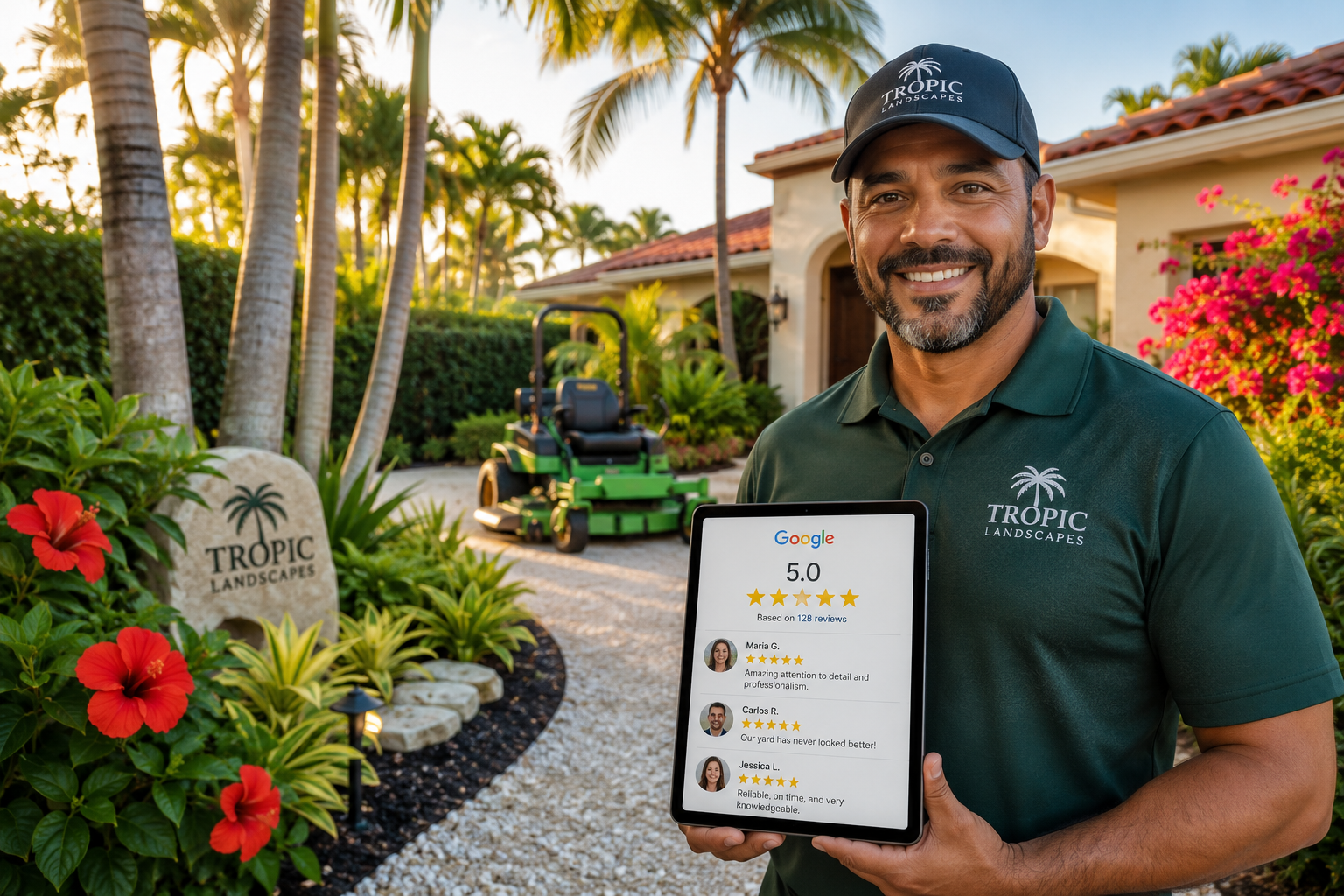
Landscaping Contractor Reviews in Miami: How to Turn Seasonal Jobs Into Year-Round 5-Star Ratings
Last updated: June 2, 2026
Quick Answer
Landscaping contractor reviews in Miami live or die on response speed and follow-up timing. The contractors dominating local search aren't the ones with the prettiest trucks — they're the ones who text a review request within 60 minutes of a finished job, reply to every review within 24 hours, and use automation to stay top-of-mind during slow months (June rains, August heat lulls, holiday weeks). Get that loop right and seasonal work compounds into a year-round 4.8+ star rating.
Key Takeaways
- Speed wins reviews. Customers who get a review request within 1 hour of job completion leave feedback at roughly 3x the rate of those asked 48 hours later.
- Miami's climate creates 4 distinct landscaping seasons — each one is a fresh opportunity for review velocity if you systemize follow-up.
- A single Voice AI Receptionist can handle storm-season call surges (hurricane cleanup, fallen palms) that would otherwise send leads to competitors.
- Bilingual review requests (English + Spanish) double response rates in Miami-Dade and Hialeah neighborhoods.
- Automated review funnels filter unhappy customers to private feedback first, protecting your public star rating.
- Reclaim 20 hours a week by automating the review-request, follow-up, and reply cycle.
- Lead response in <5 seconds during peak months (March–May) determines whether you win the recurring maintenance contract or the one-time cleanup.
What Makes a Top Landscaping Contractor in Miami Different
Top-rated Miami landscapers separate themselves in three measurable ways: response time, consistency of service quality across the rainy/dry seasons, and a documented review-generation system. The work itself is table stakes. What clients remember — and what they post about — is how fast you answered, how clean the property looked after, and whether you came back when promised.
The contractors winning the landscaping category in South Florida share four traits:
- Sub-5-minute lead response, even on weekends
- Bilingual communication (English/Spanish, sometimes Creole)
- Photo documentation sent to the client after every visit
- A standing review request workflow triggered automatically when an invoice is paid
The owner-operator working 60-hour weeks can't do this manually. The ones who scale past $500K do it with a Business Operating System — not a fragmented stack of Calendly, Mailchimp, and a notebook.
How Much Do Landscapers Typically Charge Per Project in South Florida
South Florida landscaping pricing in 2026 varies by service type, but most contractors operate within these ranges:
| Service | Typical Price Range (Miami-Dade) |
|---|---|
| Weekly lawn maintenance (¼ acre) | $35–$75/visit |
| Full yard cleanup | $250–$800 |
| Sod installation (per pallet) | $250–$450 |
| Palm tree trimming | $75–$300/tree |
| Landscape design + install | $3,500–$25,000+ |
| Mulching (per yard) | $90–$160 |
| Hurricane prep / cleanup | $400–$2,500+ |
Pricing transparency on your website and Google Business Profile is a review magnet. Customers who feel surprised by an invoice leave 1-star reviews. Customers who saw a fair estimate up front leave 5-star reviews — even when the final price is higher, as long as the change was communicated.
Best Ways to Get Consistent 5-Star Landscaping Contractor Reviews in Miami
The best way to get consistent 5-star landscaping contractor reviews in Miami is to ask every paying customer, within one hour of job completion, through their preferred channel (SMS wins). That's it. The contractors at 4.9 stars aren't lucky — they're systematic.
Here's the proven 4-step loop:
- Trigger: Crew marks job complete in the CRM (or invoice gets paid).
- Send (within 60 minutes): Automated SMS with a direct Google review link. Personalize with first name and crew leader's name.
- Filter: If the customer rates the experience <4 stars internally, route to a private feedback form. 4+ stars? Send directly to Google.
- Reply: AI drafts a response within 24 hours; owner approves with one tap.
For the full mechanics, see this guide to Google reviews automation. The contractors using this loop hit a 35–50% review conversion rate. Manual asks? Roughly 8%.
"Stop leaking leads — and stop leaking reviews. Every job you finish without a review request is a 5-star rating you'll never get back."
Common Mistakes Landscaping Contractors Make in Miami
The most common mistakes Miami landscapers make are ignoring after-hours leads, asking for reviews too late, and replying defensively to negative feedback. Each one erodes the trust signals that fuel local search rankings.
The top offenders:
- Missing calls during storm season — 80% of missed callers go straight to the next contractor on Google. (See: cost of missed calls for contractors)
- Asking for reviews days later, when the job is no longer top of mind
- Skipping Spanish-language requests in a market where 70%+ of households speak Spanish at home
- Arguing publicly with 1-star reviewers instead of turning the negative review into a positive outcome
- No photo proof of work — customers forget what the yard looked like before
- Inconsistent crew quality between seasons (new hires in March perform like new hires)
Fix any one of these and your rating moves. Fix all six and you own your zip code.
How to Handle Seasonal Fluctuations in Landscaping Work
Handle Miami's seasonal fluctuations by converting one-time jobs into recurring contracts during peak months and running review-driven retargeting campaigns during slow months. The work isn't actually seasonal — the type of work is.
Miami's landscaping calendar:
- March–May (Peak): Spring cleanups, mulching, design installs. Highest review volume opportunity.
- June–August (Rainy): Drainage work, storm prep, fast-growth maintenance. Reviews focus on responsiveness.
- September–November (Hurricane): Emergency cleanup, tree work, insurance jobs. Voice AI catches the surge.
- December–February (Dry/Cool): Pruning, sod prep, holiday lighting. Slowest cash flow — highest re-engagement opportunity.
During slow months, run automated SMS campaigns to your CRM database. A simple "Time for a winter pruning? Reply YES for a free quote" sent to 500 past clients turns dead time into booked weeks. The automated follow-up systems contractors need in 2026 make this a 10-minute setup, not a project.
Which Landscaping Services Are Most In-Demand in Miami
The highest-demand landscaping services in Miami in 2026 are recurring lawn maintenance, palm tree trimming, hurricane prep/cleanup, and tropical landscape design. Demand is split between maintenance contracts (steady revenue) and project work (high ticket).
Ranked by search volume and contract value:
- Weekly/bi-weekly maintenance — the foundation of recurring revenue
- Palm trimming and removal — high ticket, high review value
- Hurricane prep and cleanup — seasonal surge (May–November)
- Sod replacement — after every dry season and every hurricane
- Landscape design and install — highest ticket, longest sales cycle
- Drainage and grading — rainy season specialty
- Pest and weed treatment — bundles well with maintenance
- Holiday lighting — December cash flow saver
Top-rated competitors like Mallea Landscaping, Raydel Landscaping, and Patron Elite & Design dominate their niches by bundling these services and stacking reviews in each category.
How Do I Prevent Negative Online Reviews as a Landscaping Contractor
Prevent negative reviews by intercepting unhappy customers before they post. The mechanism is simple: every post-job survey routes 1–3 star feedback to a private form and 4–5 star feedback to public Google. Pair that with a 24-hour response SLA and most issues never see the public.
The prevention playbook:
- Set expectations in writing before the job (start time, scope, cleanup, payment terms)
- Send pre-arrival SMS the morning of the job — "Crew arriving 8:30 AM, lead: Marcos"
- Photo before/after every visit, sent to client via SMS
- Same-day issue resolution — if something's wrong, fix it before you leave
- Use a review filtering funnel that catches unhappy customers privately
- Reply within 24 hours to every public review, positive or negative (yes, even the 5-stars)
When a 1-star slips through, respond with a structured de-escalation script — don't go off the cuff.
What Equipment Do I Need to Start a Professional Landscaping Business
A professional Miami landscaping startup needs about $15,000–$45,000 in equipment to operate profitably. The biggest mistake is underinvesting in commercial-grade gear and overinvesting in branded trucks before revenue justifies it.
Minimum viable equipment list:
- Commercial zero-turn mower ($6,000–$12,000)
- 21" walk-behind mower for tight gates ($600–$1,200)
- Commercial backpack blower ($500–$700)
- String trimmer + edger ($500–$900 combined)
- Hedge trimmer (gas or battery) ($300–$600)
- Chainsaw for palm work ($400–$1,200)
- Enclosed trailer ($4,000–$10,000)
- F-150 or equivalent truck ($25,000–$45,000 used)
- Safety gear, hand tools, fuel cans ($1,000+)
The non-equipment essentials matter more for review velocity: a CRM, a website with web chat, a booking calendar, and an AI receptionist that answers when you're on the mower. Most new contractors skip these and wonder why their phone rings but never converts.
Are There Specific Landscaping Challenges Unique to Miami's Climate
Miami's subtropical climate creates landscaping challenges most U.S. contractors never see: year-round growing seasons, hurricane debris, salt air on coastal properties, and invasive species pressure. The contractors who turn these into reviews are the ones who explain the challenge to the homeowner before billing for it.
Climate-specific issues:
- Hurricane season (June–November) — fallen trees, debris cleanup, insurance documentation
- Salt-air corrosion near Biscayne Bay and the beaches kills landscape lighting and irrigation
- Year-round mowing — no winter dormancy means weekly cuts March–October
- Chinch bug and sod webworm pressure on St. Augustine lawns
- Invasive species (Brazilian pepper, air potato) require ongoing removal
- Sandy soil means heavy fertilizer and irrigation dependence
- Flooding and drainage issues during the rainy season
Educate clients in writing — use SMS, email, or your website. Homeowners who understand why the work costs what it does leave 5-star reviews. Homeowners who feel ambushed by a $400 chinch bug treatment leave 1-stars.
How Can Landscapers Market Themselves During Slow Seasons
Landscapers market themselves during slow seasons by re-engaging existing customers through automated SMS and email, running review-generation pushes, and bundling services for the upcoming peak. The slow season is when your customer database becomes your most valuable asset — if you've been building it.
Slow-season playbook (December–February):
- Re-engagement SMS to all past clients: "Ready for spring? Lock in March slots now."
- Bundle offers: "Mulch + pruning + cleanup — $499, this month only."
- Review velocity push to clients you serviced in November
- Google Business Profile updates — new photos weekly, weekly posts
- Referral campaign — "Refer a neighbor, get a free cut"
- Spanish-language outreach to your Hialeah and Doral list
- Content marketing — short blog posts and Reels about Florida hurricane prep
With the right marketing automation stack, this entire cycle runs itself. You set the campaigns in November, they execute through February, and you walk into March with a full calendar.
What Credentials or Certifications Help Landscaping Contractors Stand Out
The credentials that move the needle on reviews and trust signals in Miami are FNGLA certification, Miami-Dade local business tax receipt, ISA Certified Arborist status, and pesticide applicator licensing. Most homeowners don't know what these mean — but they recognize that you have them, and they cite them in reviews.
Worth pursuing in 2026:
- FNGLA Florida Certified Horticulture Professional — the gold standard in FL
- ISA Certified Arborist — critical for palm and tree work
- Florida Pesticide Applicator License — required for any chemical treatment
- Miami-Dade Local Business Tax Receipt — legal requirement, also a trust signal
- General liability insurance ($1M+) — list it on your website
- Workers' comp coverage — protects you and reassures clients
- A2P-registered SMS — so your review requests don't go to spam (A2P registration is essential for automated texts)
Add these as badges on your website footer and Google Business Profile description. They convert.
Tips for Managing Customer Expectations in Landscaping Projects
Manage customer expectations by documenting scope, timeline, and payment terms in writing before any work begins, then over-communicating during the project. Most landscaping disputes (and 1-star reviews) come from one missed text, not bad work.
The 5-point expectation framework:
- Written scope — exactly what's included, what's not, what costs extra
- Realistic timeline — pad by 20% for weather delays during rainy season
- Payment schedule — deposits, milestones, final payment terms
- Photo updates — before, during, after, sent same-day
- Pre-arrival confirmation — every visit, every time
Pair this with a bilingual AI receptionist so questions get answered the moment the client asks them — not whenever you check voicemail at 9 PM. Speed of communication is the single biggest driver of perceived quality.
FAQ
How many Google reviews does a Miami landscaping contractor need to rank in the local 3-pack?
Most ranked Miami landscapers in 2026 have between 75 and 250 Google reviews with a 4.6+ average. Velocity (reviews per month) matters as much as total count.
Should I offer discounts in exchange for reviews?
No. It violates Google's review policy and can get your profile suspended. Ask for honest reviews — that's it.
How fast should I reply to a new landscaping lead in Miami?
Under 5 minutes ideally, under 60 seconds for best conversion. After 5 minutes, conversion drops by roughly 80%.
What's the fastest way to get more 5-star reviews this month?
Send an SMS review request to every customer you've serviced in the last 30 days. Use a direct Google review link. Expect 30–40% to respond if the work was good.
Can AI really respond to reviews in my brand voice?
Yes. Modern review-response AI drafts replies based on your past responses and brand tone. You approve with one tap before it posts.
Do I need a separate phone for business calls?
Use a Voice AI Receptionist instead. It answers 24/7, books appointments, and never lets a lead go to voicemail.
How do I handle a fake review from a competitor?
Flag it through Google's review removal process with documentation (no record of the customer in your CRM is your strongest evidence). Reply publicly and professionally while you wait.
Is bilingual customer service really worth it in Miami?
Yes. Over 70% of Miami-Dade households speak a language other than English at home. Bilingual review requests convert at 2x the rate of English-only.
Conclusion: Turn Every Job Into a 5-Star Asset
Miami landscaping is a relationship business disguised as a labor business. The crews that win in 2026 aren't cutting grass better — they're closing the loop between finished work and posted review faster than anyone else. Every job becomes a marketing asset. Every review becomes a ranking signal. Every slow season becomes a re-engagement campaign.
Your next steps:
- Audit your current review velocity. How many reviews per month, on average?
- Install a missed-call text-back system so no after-hours lead leaks to a competitor.
- Automate review requests via SMS within 60 minutes of job completion.
- Set up an AI receptionist to handle storm-season call surges.
- Run a re-engagement campaign to every past client before the next slow season.
The contractors hitting 4.9 stars and full calendars year-round aren't working harder. They're running a unified AI ecosystem that turns every interaction into a review, every review into a ranking, and every ranking into a booked job. Ready to see what that looks like for your business? Book a demo with Hawk Guru and we'll show you the system in 15 minutes.
Meta Title: Landscaping Contractor Reviews in Miami: 5-Star Playbook
Meta Description: Turn seasonal landscaping jobs into year-round 5-star Google reviews in Miami. Proven automation, scripts, and seasonal strategies for 2026.
Tags: landscaping contractor reviews Miami, landscaper Google reviews, Miami landscaping reputation, review automation contractors, South Florida landscaping, seasonal landscaping marketing, hurricane prep landscaping, bilingual review requests, contractor CRM Florida, Miami home services marketing, Hawk Guru, AI receptionist landscapers