What to Do When a Competitor Leaves Fake Google Reviews on Your Miami Business Profile
Last updated: June 2, 2026
Quick Answer
When a competitor leaves fake Google reviews on your Miami business profile, take four actions in this order: document every suspicious review with screenshots and timestamps, flag each one through Google Business Profile, submit a formal removal request via Google's support form, and respond professionally in public while you wait. If the attack is coordinated or defamatory, Florida law (FDUTPA and tortious interference) gives you legal options. Most legitimate flag requests resolve within 3 to 10 business days when the evidence is clean.
Key Takeaways
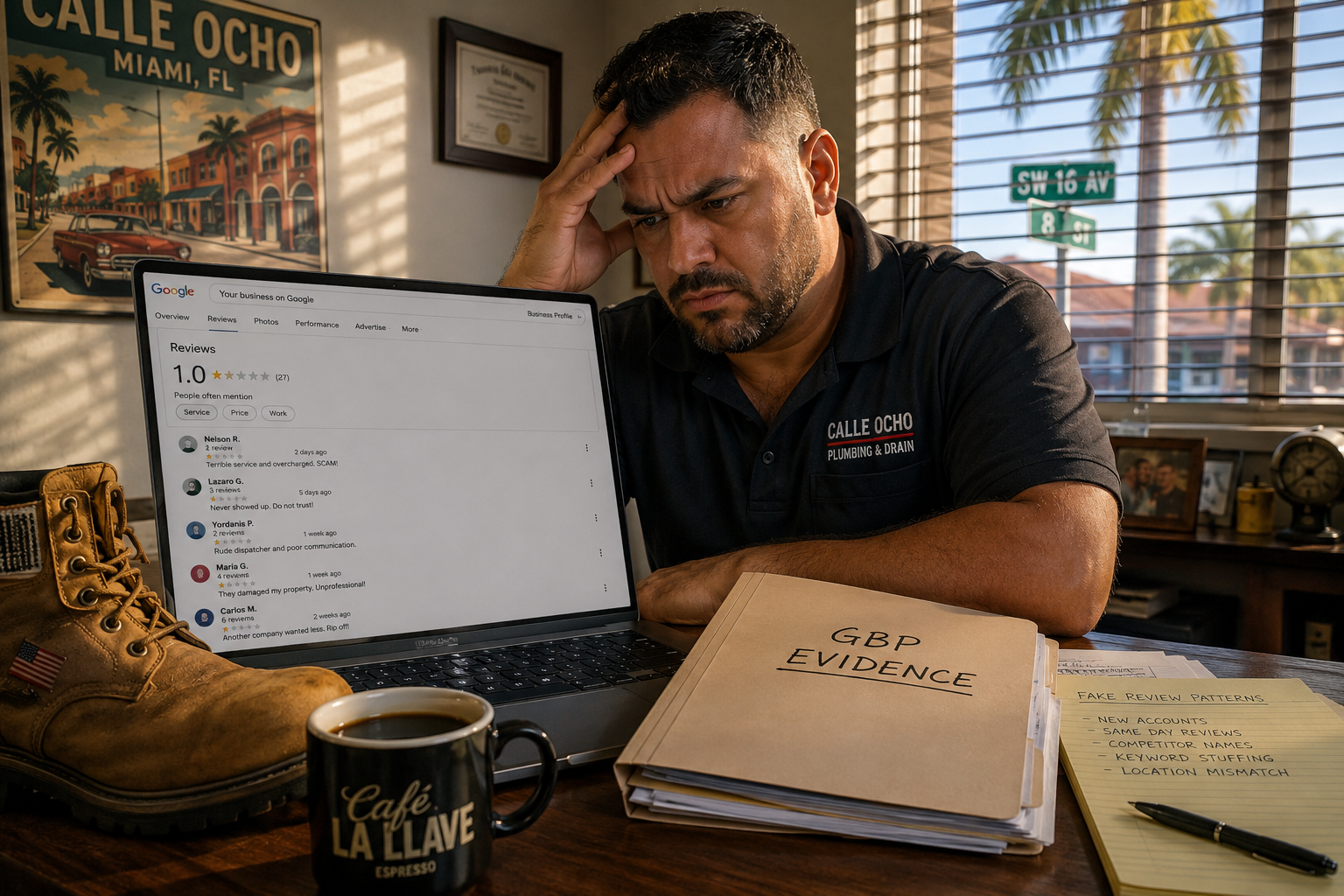
- Fake Google reviews competitor Miami attacks typically come in clusters of 1-star ratings within 24–72 hours from accounts with no prior local activity.
- Google removes reviews that violate its policies — not reviews you simply dislike. Evidence matters.
- Florida's Deceptive and Unfair Trade Practices Act (FDUTPA) and federal FTC rules give you legal leverage when fake reviews are traceable to a competitor.
- A single fake 1-star review can cost a small Miami service business an estimated $3,000–$9,000 in lost lead value over 12 months (based on average local LTV).
- Speed wins. Flag within 24 hours. Respond publicly within 48. Escalate to Google's legal team if standard flagging fails.
- Automated review generation is the single best defense — burying fakes under a steady flow of real 5-star reviews from verified customers.
- The FTC's 2024 rule on fake reviews now allows civil penalties up to $51,744 per violation against businesses that post or buy fake reviews.
How do competitors typically leave fake reviews?
Competitors rarely use their own accounts. The attack pattern in Miami is predictable, and recognizing it is half the battle.
Common tactics:
- Burner Gmail accounts created within the last 30 days, often with no profile photo and 0–2 prior reviews.
- Offshore review-for-hire services sourced through gig platforms — accounts based in countries with no business activity in South Florida.
- Coordinated friend-and-family campaigns where the competitor's network leaves 1-star reviews within a tight time window.
- Negative-only review patterns where the same account leaves 1-star reviews on multiple competing Miami HVAC, roofing, or plumbing businesses but never positive reviews.
- Vague, non-specific complaints like "terrible service, never again" with no job details, technician name, or date.
Decision rule: If three or more 1-star reviews land inside 72 hours from accounts with no Miami activity history, treat it as a coordinated attack — not a coincidence.
How can I tell if a Google review is fake?
A review is likely fake when the reviewer has no verifiable connection to your business, uses vague language, and matches a suspicious account pattern. Look for these signals together — one alone isn't proof.
Red flags checklist:
| Signal | What to Look For |
|---|---|
| Reviewer history | 0–3 lifetime reviews, all 1-star, no photos |
| Account age | Created within last 60 days |
| Geographic mismatch | Reviewer's other reviews are in countries outside the US |
| Generic language | "Worst company ever" with no service details |
| Timing cluster | Multiple negative reviews within 24–72 hours |
| No job record | Name doesn't match any customer in your CRM |
| Copy-paste patterns | Similar phrasing across multiple reviews |
Quick example: A Miami plumber receives four 1-star reviews on a Tuesday afternoon. None of the names match jobs in the AI CRM lead tracking system. Three accounts were created in the last week. That's a coordinated attack, not legitimate feedback.
What evidence do I need to prove reviews are fake?
Google requires specific, verifiable evidence — not opinions. The stronger your documentation, the faster removal happens.
Evidence to collect for every suspicious review:
- Full screenshot of the review, reviewer profile, and reviewer's other reviews.
- Timestamp of when the review appeared (Google Business Profile dashboard shows this).
- CRM record check confirming the reviewer is not in your customer database. A CRM owner dashboard makes this a 30-second search.
- No service history in your booking system, invoicing software, or call logs.
- Pattern documentation — if multiple reviews share IP-like patterns, language, or timing.
- Competitor connection if available (e.g., reviewer's profile photo matches a competitor's employee on LinkedIn).
Common mistake: Reporting a review as fake just because it's negative. Google rejects these. Only flag reviews that violate the Google review content policies.
What are the steps to report fake reviews on Google My Business?
Reporting a fake review takes three layers — flag it, escalate it, then submit a formal removal request. Most Miami business owners stop at step one and wonder why nothing happens.
Step-by-step process:
- Flag inside Google Business Profile. Open the review, click the three dots, select "Report review," and choose the violation type (typically "Off topic," "Conflict of interest," or "Fake engagement").
- Wait 3–5 business days. Google's automated system reviews the flag.
- If not removed, submit a formal removal request through Google's Business Redressal Complaint Form. This goes to a human reviewer.
- Provide your evidence packet — screenshots, CRM proof, timing analysis.
- Escalate via Google Small Business Twitter/X support (@GoogleSmallBiz) with your case number if no response in 10 days.
- Contact Google Business Profile support directly through your dashboard help menu — request a callback.
- For coordinated attacks, send a legal preservation letter through an attorney citing Google's Terms of Service violations.
- Document everything for potential FTC complaint and Florida AG submission.
Can Google remove fake negative reviews for my Miami business?
Yes — Google can and does remove reviews that violate its policies, but only when the violation is clear. Roughly 60–70% of well-documented fake review flags are removed within 7–14 days. The rest require escalation or legal pressure.
Reviews Google will remove:
- Reviews from people who never used your service (policy: "fake engagement")
- Reviews from competitors or their employees (policy: "conflict of interest")
- Reviews containing profanity, hate speech, or threats
- Reviews about a different business
- Off-topic content (political rants, personal grievances unrelated to service)
- Reviews that include private information
Reviews Google will not remove:
- Negative but truthful reviews
- Reviews you disagree with
- Reviews about a real customer experience, even if poorly worded
- 1-star ratings with no text (unless tied to a flagged account)
For deeper tactics on review removal disputes, see Hawk Guru's guide to removing fake Google reviews.
How long does Google take to investigate review complaints?
Google's published timeline is 3–5 business days for initial review. In practice, Miami service businesses see resolution between 3 and 21 days depending on case complexity.
Realistic timeline:
- In-dashboard flag: 3–5 business days
- Redressal form submission: 5–10 business days
- Escalation via @GoogleSmallBiz: 2–7 days
- Legal counsel involvement: 10–30 days
- Coordinated attack with FTC complaint: 30–90 days
Edge case: During Miami's hurricane season (June–November), Google's small business support response times often slow by 2–4 days. Submit faster, follow up harder.
Legal options for dealing with competitor review attacks in Florida
Florida gives you real legal teeth when a competitor is behind a fake review attack. The two strongest paths are FDUTPA and tortious interference claims, plus federal FTC enforcement.
Your legal toolkit:
- FDUTPA (Florida Deceptive and Unfair Trade Practices Act): Allows civil action against competitors using deceptive practices. Damages plus attorney's fees are recoverable.
- Tortious interference with business relationships: If fake reviews cost provable customers, you can sue for lost revenue.
- Defamation per se: False statements injuring your business reputation are actionable in Florida. Truth is a defense — but fake reviewers don't have it.
- FTC complaint: The FTC's 2024 Rule on Consumer Reviews and Testimonials makes posting fake reviews about competitors a federal violation with penalties up to $51,744 per review.
- Cease and desist letter: Often the fastest, cheapest first step. A Miami attorney can draft one for $300–$800.
- Subpoena to Google: With an active lawsuit, you can subpoena reviewer IP addresses to unmask anonymous attackers.
Choose litigation if: the financial damage exceeds $25,000, you have evidence linking reviews to a specific competitor, and Google has refused removal.
How much damage do fake reviews actually do to a small business?
A single fake 1-star review can drop your average rating, cut click-through rates by 5–9%, and cost a small Miami service business $3,000–$9,000 in lost lead value over 12 months. Multiple fakes compound the damage.
The math behind the loss:
For a Miami HVAC company with an average customer LTV of $1,800 and a typical close rate of 35% on Google leads:
$$\text{Annual Loss} = \text{Lost Leads/Month} \times 12 \times \text{Close Rate} \times \text{LTV}$$
If a fake review cluster reduces monthly Google-sourced leads by just 4, that's:
$$4 \times 12 \times 0.35 \times $1{,}800 = $30{,}240$$
The damage isn't just rating math. It's:
- Reduced map pack visibility
- Lower click-through from search results
- Trust collapse from prospects reading the review before booking
- Damage to Google Local Services Ads quality scores
For benchmarks on review counts and rankings, see how Google reviews affect local rankings.
Can fake reviews hurt my search rankings?
Yes. Google's local ranking algorithm weighs review quantity, quality, recency, and velocity. A burst of negative reviews — even fake ones — can demote a Miami business in the map pack within 7–14 days.
Ranking impact factors:
- Star rating drop: Falling from 4.8 to 4.4 typically pushes a business 1–3 positions lower in the map pack.
- Review velocity: Sudden negative spikes signal "instability" to Google's algorithm.
- Engagement signals: If fake reviews go unanswered, Google interprets it as poor business management.
- AI Overviews exposure: AI search systems now factor review sentiment when recommending local businesses, as detailed in this guide on how AI answer engines change local search.
Best ways to respond to fake negative reviews
Respond publicly, professionally, and factually. Your response isn't for the fake reviewer — it's for the next 100 prospects who'll read it.
Response template that works:
"Thank you for the feedback. We take all reviews seriously, but after a thorough search of our records, we have no service history matching this account. We've flagged this review with Google for investigation. If you are a real customer with a real concern, please contact us directly at [phone] so we can resolve it immediately."
Response rules:
- Stay calm. Never accuse the reviewer of lying publicly — state facts.
- Reference your records. "No record in our CRM" is powerful.
- Offer direct contact. Real customers will reach out. Fake reviewers won't.
- Keep it short. 3–4 sentences maximum.
- Respond within 48 hours. Speed signals professionalism.
For more response frameworks, see Hawk Guru's tactical guide to dealing with a 1-star Google review.
Are there services that help remove fake Google reviews?
Yes, but choose carefully. Legitimate reputation management services work within Google's policies. Shady ones promise guaranteed removal — and often violate Google's TOS, putting your profile at risk of suspension.
What legitimate services do:
- Audit and document suspicious reviews
- File proper Google flags with full evidence packets
- Escalate via Google support and legal channels
- Build a steady flow of authentic 5-star reviews to bury fakes
- Monitor your profile 24/7 with automated alerts
Red flags to avoid:
- "100% guaranteed removal" claims (impossible)
- Offers to buy positive reviews
- Services using black-hat scraping or bot networks
- No transparent reporting
Hawk Guru's platform handles this through automated Google reviews automation combined with reputation management for competitor fake reviews.
How much do fake review removal services cost in Miami?
Pricing in Miami ranges from $99/month for automated monitoring to $2,500+ for full legal-grade removal campaigns.
Typical pricing tiers:
| Service Level | Monthly Cost | Includes |
|---|---|---|
| Automated monitoring & response | $99–$199 | Alerts, flagging, AI responses |
| Managed ORM | $300–$800 | Manual review, custom replies, escalation |
| Legal-grade removal | $1,500–$3,500 | Attorney letters, FTC filings, Google legal escalation |
| Crisis recovery (post-attack) | $2,500–$7,500 one-time | Full removal campaign + review velocity rebuild |
Hawk Guru's reputation management is built into the Professional and Elite plans — replacing standalone ORM tools that average $400/month.
Penalties for businesses that post fake reviews
The FTC's 2024 Rule on Consumer Reviews and Testimonials made fake reviews a federal violation with steep penalties. Florida adds its own consumer protection penalties on top.
Federal penalties (FTC, effective 2024):
- Up to $51,744 per violation (per fake review)
- Injunctions against future violations
- Mandatory disclosure orders
- Class action liability
Florida penalties:
- FDUTPA civil penalties up to $10,000 per violation
- Actual damages + attorney's fees
- Potential criminal fraud charges in egregious cases
For Miami competitors caught attacking: a 10-review coordinated attack could result in $517,440 in federal fines alone. The risk-reward math is brutal for the attacker — which is why documentation matters.
How to build long-term defense against fake review attacks
Removal is reactive. The real defense is volume. Burying fake reviews under a steady stream of authentic 5-star reviews from real customers makes any single attack statistically irrelevant.
The Hawk Guru defense playbook:
- Automate review requests via SMS the moment a job closes — see Hawk Guru's framework for automating Google review requests after every job.
- Target 4–8 new reviews per month minimum for HVAC, roofing, and plumbing businesses.
- Monitor in real-time with alerts the moment any new review hits your profile.
- Respond to 100% of reviews — positive and negative — within 48 hours.
- Use a unified inbox so review monitoring isn't a separate task.
- Build review velocity diversification — if your only review channel is Google, you're vulnerable. Add Facebook, Yelp, and industry directories.
A business with 287 reviews at 4.9 stars feels three fake 1-star reviews. A business with 14 reviews at 4.6 stars feels devastated.
FAQ
Q: Can I sue a competitor for posting fake reviews in Florida?
Yes. Florida's FDUTPA and tortious interference statutes allow civil action with damages and attorney's fees if you can prove the competitor is behind the reviews.
Q: Will responding to a fake review make it worse?
No. A professional, factual response protects you. Silence signals guilt to future prospects.
Q: How do I prove a review came from a competitor?
Patterns help: matching IP ranges (subpoena required), employee names matching competitor LinkedIn, identical phrasing across attacks, and timing coordinated with your marketing pushes.
Q: Does Google penalize businesses for too many flagged reviews?
No — flagging legitimate violations doesn't hurt you. Buying or posting fake reviews yourself does.
Q: What if Google refuses to remove a clearly fake review?
Escalate via the redressal form, then @GoogleSmallBiz on X, then through a legal preservation letter from an attorney citing Google's TOS.
Q: Can AI help me detect fake reviews faster?
Yes. AI review monitoring tools flag suspicious patterns — new accounts, geographic mismatches, language similarity — within seconds.
Q: How fast should I respond to a fake review?
Within 24–48 hours. Speed-to-response is a trust signal for every prospect who reads the review later.
Q: Is it legal to buy positive reviews to offset fakes?
No. The FTC's 2024 rule makes buying reviews a federal violation. Use automation to generate real reviews from real customers instead.
Conclusion: Defend Today, Build Tomorrow
Fake Google reviews from competitors are a Miami service business reality — not an anomaly. The owners who survive aren't the ones who flag fastest. They're the ones who built a review engine so strong that fakes drown in real customer voices.
Your next 48 hours:
- Audit every review on your Google Business Profile against your CRM.
- Flag every suspicious review with full evidence.
- Respond publicly to every fake within 48 hours.
- Install an automated review request system on every closed job.
- Set up real-time review monitoring alerts.
Hawk Guru is the Business Operating System for 2026 — combining AI-powered review automation, competitor attack monitoring, and a unified inbox that catches every customer touchpoint. Stop leaking leads to fake review attacks. Start your 14-day free trial or book a demo and let the system defend your reputation while you run your business.
From lead to loyal client — with hawk-eyed precision.
Sources
- Federal Trade Commission. "Rule on the Use of Consumer Reviews and Testimonials." 2024. https://www.ftc.gov/legal-library/browse/rules
- Google. "Prohibited & Restricted Content for Maps User Contributions." 2024. https://support.google.com/contributionpolicy/answer/7400114
- Florida Statutes. "Deceptive and Unfair Trade Practices Act (FDUTPA), Chapter 501." https://www.leg.state.fl.us
- Google Business Profile Help. "Report a Policy Violation." 2024. https://support.google.com/business
Meta Title: Fake Google Reviews from Competitors in Miami: 2026 Action Guide
Meta Description: A Miami business owner's playbook for removing fake Google reviews from competitors. Evidence, legal options, Google reporting, and defense tactics that work in 2026.
Tags: fake Google reviews, competitor review attacks Miami, Google Business Profile, reputation management Miami, FDUTPA, FTC review rule, remove fake reviews, Miami home services, online reputation defense, review automation, Google review policy, contractor reputation