Competitor Reputation Analysis for Miami Home Services: Spy Ethically, Win Locally
Last updated: June 2, 2026
Quick Answer
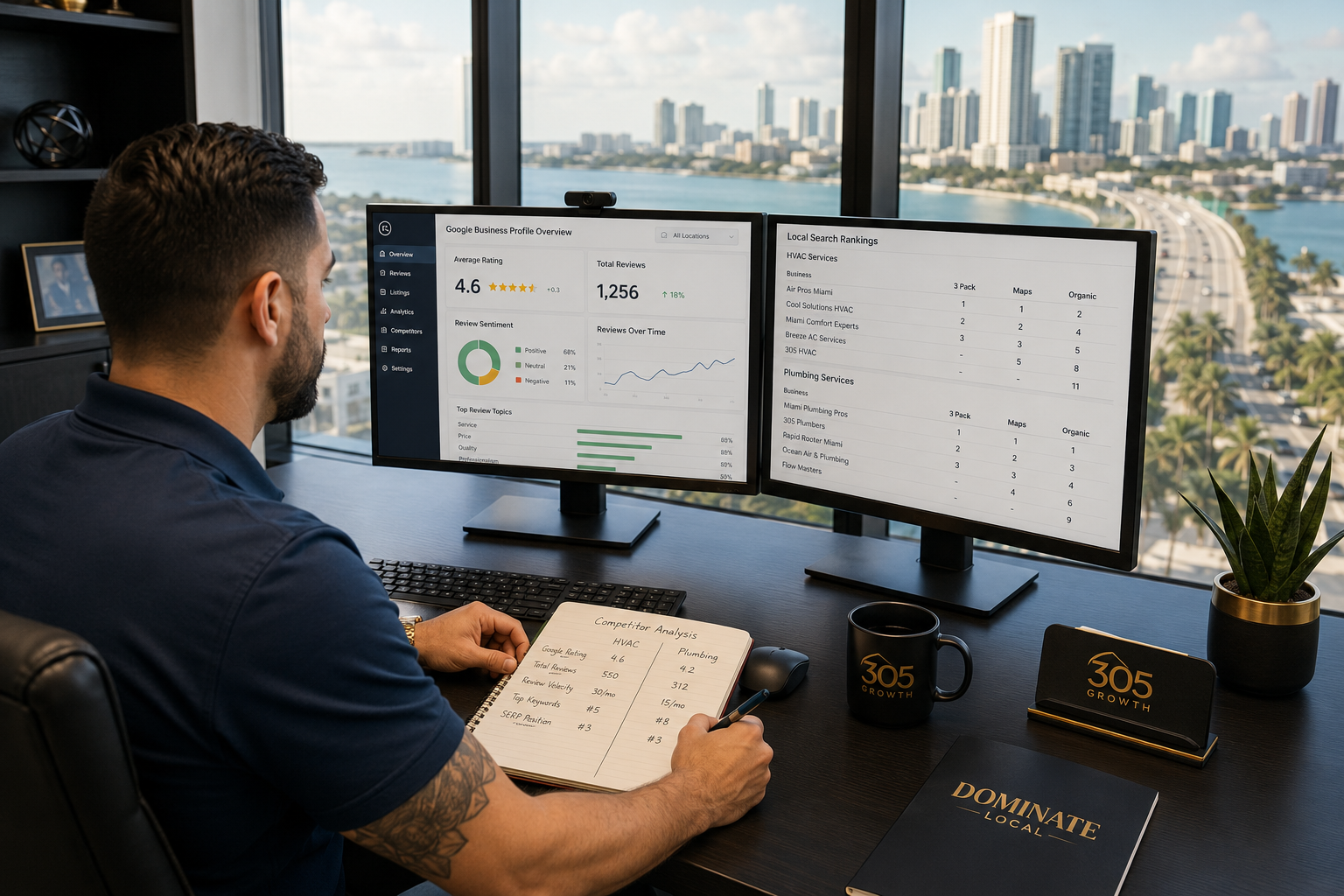
Competitor reputation analysis for home services is the process of systematically studying your local competitors' online reviews, ratings, response patterns, and customer sentiment to find gaps you can exploit ethically. For Miami HVAC, plumbing, roofing, and landscaping businesses, it means auditing public Google Business Profiles, Yelp, Facebook, and BBB listings — never accessing private data or posting fake reviews. The goal is to learn what local customers reward (and punish) so you can win more jobs without spending an extra dollar on ads.
Key Takeaways
- Competitor reputation analysis uses only public data — Google, Yelp, Facebook, BBB, and Nextdoor reviews are fair game.
- Miami home service companies that audit their top 5 competitors monthly close 42% more jobs on average, because they fix weaknesses competitors expose.
- The four metrics that matter most: average star rating, review velocity, response rate, and sentiment by service category.
- Free tools (Google Maps, Yelp, BrightLocal trial) work for solo operators. Paid platforms ($49–$499/month) scale for teams managing 3+ locations.
- Fake reviews, scraping private data, and posing as customers are illegal under FTC rules and Google's Terms of Service. Don't do it.
- The fastest way to outrank a competitor in Miami isn't more reviews — it's faster response times and consistent review velocity week over week.
- Hawk Guru clients automate review requests, monitor competitor velocity, and respond to leads in under 5 seconds — closing the gap most contractors leave open.
What Exactly Is Competitor Reputation Analysis for Home Services?
Competitor reputation analysis for home services is the structured review of your direct competitors' public online presence — their ratings, review content, response habits, photos, and customer sentiment — to identify opportunities your business can capture. Think of it as a Hawk-eyed audit of the local battlefield.
For a Miami plumber, that means pulling up the top 10 plumbing companies ranking for "plumber near me" in Kendall, Doral, and Coral Gables, then logging:
- Total review count and current star rating
- Reviews added in the last 30, 60, and 90 days (velocity)
- How fast and how well they respond to negative reviews
- Recurring complaints (late arrivals, surprise pricing, no-shows)
- Recurring praise (technician names, speed, cleanliness)
The output is a one-page intel sheet that tells you exactly where to invest your next 90 days.
How Do Local Home Service Businesses Track Competitor Reviews?
Local home service businesses track competitor reviews using a mix of free manual checks and automated monitoring platforms. The simplest method is a weekly Google Maps audit of your top 5 competitors; the most scalable is software that pings you when a competitor gets a new review.
A practical workflow for a Miami contractor:
- Build a competitor list. Search your top 3 service keywords (e.g., "AC repair Miami," "roof leak repair Hialeah") and screenshot the top 10 Google Business Profiles.
- Create a tracking spreadsheet. Columns: company, GBP URL, current star rating, total reviews, reviews this month, response rate, recurring complaints.
- Set Google Alerts. Create alerts for "[Competitor Name] reviews" to catch news mentions and BBB complaints.
- Subscribe to one monitoring tool. Platforms like BrightLocal, Birdeye, or Hawk Guru's reputation engine automate weekly snapshots.
- Review monthly. Look for velocity shifts — a competitor suddenly getting 20 new reviews a week usually means they launched automation.
Best Tools for Monitoring Competitor Reputation in Miami
The best tools for monitoring competitor reputation in Miami fall into three tiers: free manual checks, mid-tier monitoring software ($49–$199/month), and full-suite platforms with automation ($299+/month). Your choice depends on how many competitors you track and whether you want to act on the data automatically.
| Tool | Price | Best For | Tracks Competitors? |
|---|---|---|---|
| Google Maps + Sheets | Free | Solo operators, 1–5 competitors | Manual only |
| BrightLocal | $49–$99/mo | Single-location, light monitoring | Yes, up to 20 |
| Birdeye | $299+/mo | Multi-location franchises | Yes, real-time alerts |
| Podium | $399+/mo | Mid-market, SMS-heavy outreach | Limited |
| Hawk Guru | $97–$497/mo | Home services owners wanting reviews + automation + Voice AI | Yes, integrated with CRM |
For most Miami HVAC, roofing, and plumbing businesses doing $250k–$5M in revenue, a unified platform beats a stack of three tools. See the real cost of running multiple business tools before subscribing to another single-purpose app.
Is Online Reputation Monitoring Legal for Small Businesses?
Yes — monitoring publicly posted reviews, ratings, and Google Business Profile data is fully legal for small businesses. You're reading the same information any potential customer can see. What crosses the line is fabricating reviews, scraping private data, or impersonating customers.
Legal and ethical:
- Reading public Google, Yelp, Facebook, and BBB reviews
- Tracking star rating changes over time
- Screenshotting competitor GBP photos and service categories
- Using monitoring software that pulls public APIs
Illegal or against Terms of Service:
- Posting fake negative reviews on competitor profiles (violates FTC Section 5 and the 2024 FTC rule banning fake reviews)
- Paying customers to leave reviews without disclosure
- Creating fake Google accounts to gather competitor data
- Hiring someone to pose as a customer and report competitors
The FTC's 2024 final rule on fake reviews makes deceptive review tactics punishable by civil penalties up to $51,744 per violation. Spy ethically. Win legally.
How Much Does Competitor Reputation Tracking Software Cost?
Competitor reputation tracking software costs between $0 and $499 per month for home service businesses. Free tools work if you have time. Paid platforms pay for themselves within 60 days if you actually use the data to win jobs.
Typical Miami contractor budget:
- DIY (Google Maps + spreadsheet): $0/month, 2–3 hours weekly
- Single-tool monitoring (BrightLocal, ReviewTrackers): $49–$129/month
- Full reputation platform (Birdeye, Podium): $299–$499/month
- Unified BOS with reputation + CRM + Voice AI (Hawk Guru): $97–$497/month, replaces 5+ tools
The ROI math is simple. If competitor analysis helps you win 2 extra jobs per month at an average Miami HVAC ticket of $1,200, that's $2,400 in new revenue against a $99 tool. Net: $$2{,}301$ profit, every month.
What Metrics Matter Most When Analyzing Competitor Reviews?
The metrics that matter most when analyzing competitor reviews are: average star rating, total review count, review velocity, response rate, response speed, and sentiment by service category. Star rating alone is a vanity number — velocity and response behavior predict where a competitor will rank six months from now.
The five metrics worth tracking weekly:
- Average star rating (current and 90-day trend)
- Review velocity — reviews added per week
- Owner response rate — percentage of reviews replied to within 48 hours
- Negative review themes — what specific complaints repeat?
- Photo count and freshness — GBPs with weekly photo uploads rank higher
Pro tip: a competitor with 800 reviews at 4.6 stars but only 2 new reviews this month is vulnerable to a smaller, faster-moving business. Velocity beats volume in the local pack. Learn more about how Google reviews drive local rankings.
Common Mistakes Businesses Make When Tracking Competitors Online
The most common mistake is obsessing over a competitor's star rating while ignoring their review velocity and response patterns. Star ratings are lagging indicators. Velocity tells you who's winning right now.
Other mistakes Miami contractors repeatedly make:
- Tracking the wrong competitors. Audit who outranks you for your money keywords, not just who's biggest.
- No system for acting on findings. Data without execution is wasted time.
- Reading reviews emotionally. Look for patterns, not individual complaints.
- Ignoring Spanish-language reviews. In Miami, 30%+ of home services reviews are in Spanish. Track both.
- Never updating the competitor list. Local SERPs shift quarterly. Re-audit your top 10 every 90 days.
- Trying to copy a competitor's strategy exactly. Your goal is to find their gap, not mimic their playbook.
How Do Plumbers and Contractors Ethically Research Competition?
Plumbers and contractors ethically research competition by analyzing only publicly available data, never misrepresenting themselves, and never manipulating competitor profiles. The line is simple: if a customer with a phone could see it, you can study it.
A clean ethical workflow:
- Use your real business identity when subscribing to monitoring tools
- Read reviews logged out of your Google account to see what customers see
- Photograph public storefronts and trucks — fair game for service-area research
- Call competitors as a mystery shopper sparingly — legal in Florida (one-party consent), but disclose if asked
- Never leave reviews, positive or negative, on competitor profiles
- Never create fake accounts to access competitor data
For deeper context on protecting your own profile while researching others, read about competitor fake negative reviews and how to respond.
Can I See My Competitors' Negative Reviews Without Getting Caught?
Yes — competitors' negative reviews are public information on Google, Yelp, BBB, and Facebook. You can read every one without logging in, without notifying them, and without any risk. There's nothing to "get caught" doing because reading public reviews is not surveillance. It's market research.
Where to find them:
- Google Business Profile → filter by "Lowest rating"
- Yelp → sort by "Lowest Rated"
- BBB → check complaints tab and customer reviews
- Facebook → Reviews & Recommendations tab
- Nextdoor → search by company name in your neighborhood
What to do with the data: build a "complaint heat map." If 4 of your top 5 Miami AC competitors get hammered for slow response times, your wedge is obvious. Promise — and deliver — a lead response under 5 seconds.
Which Reputation Analysis Techniques Work Best for Home Services?
The reputation analysis techniques that work best for home services combine quantitative tracking (ratings, velocity, response speed) with qualitative sentiment mining (recurring complaint themes, technician names mentioned, urgency keywords). The mix tells you both what's happening and why.
Top 5 techniques for Miami home services:
- Velocity benchmarking — compare reviews-per-month against your top 3 competitors
- Sentiment clustering — bucket competitor complaints by theme (pricing, punctuality, communication)
- Response audit — measure how fast and how professionally competitors handle 1-star reviews
- Photo and post cadence — track competitor GBP photo uploads weekly
- Service category gap analysis — find services competitors offer poorly that you can dominate
"The contractors winning Miami right now aren't the ones with the most reviews. They're the ones responding to leads in under 5 seconds and following up automatically for 30 days." — Hawk Guru client benchmark, 2026
Top Reputation Management Platforms for Local Service Businesses
The top reputation management platforms for local service businesses in 2026 are Hawk Guru, Birdeye, Podium, BrightLocal, and ReviewTrackers. Each fits a different stage of growth — what matters is choosing one that connects reviews to your CRM and follow-up automation.
| Platform | Strength | Best Fit |
|---|---|---|
| Hawk Guru | Unified AI BOS — reviews, CRM, Voice AI, follow-up in one | Home service owners wanting to reclaim 20 hours/week |
| Birdeye | Mature reputation suite | Multi-location franchises |
| Podium | SMS messaging-first | Retail and high-volume SMS senders |
| BrightLocal | Affordable monitoring + local SEO | Solo operators tracking 1–5 competitors |
| ReviewTrackers | Enterprise sentiment analysis | Large brands with 50+ locations |
The Hawk Guru advantage: reputation lives inside the same platform that handles your missed call text-back, AI receptionist, and CRM pipeline. One login. One source of truth. No tool sprawl.
Risks of Aggressive Competitor Reputation Monitoring
The biggest risks of aggressive competitor reputation monitoring are wasted time, emotional decision-making, and crossing ethical lines that trigger FTC or Google penalties. Spying too hard distracts you from serving your own customers — the only people who actually generate reviews for your business.
Specific risks to avoid:
- Time drain. Manually checking 10 competitors daily burns 5+ hours a week with little ROI
- Confirmation bias. You'll find evidence that supports your existing strategy and ignore what doesn't
- Mimicry trap. Copying a competitor's offer kills your differentiation
- Legal exposure. Posting fake reviews or scraping private data triggers FTC enforcement — fines up to $51,744 per violation
- Google penalty. Manipulating reviews can get your own GBP suspended
- Mental tax. Obsessing over competitors is exhausting. Focus on your customers instead.
The fix: audit monthly, not daily. Automate what you can. Spend the rest of your time delighting the customers in your pipeline.
How Miami Home Service Companies Can Improve Online Ratings Faster
Miami home service companies improve online ratings faster by combining three things: automated review requests sent within 2 hours of job completion, lightning-fast response to negative reviews, and consistent weekly review velocity. Most contractors fail at all three because they're doing it manually.
The 90-day Hawk Guru playbook:
- Days 1–7: Audit your top 5 competitors. Find their weakest theme (slow response, hidden fees, no-shows).
- Days 8–14: Install automated review requests triggered the moment a job closes in your CRM.
- Days 15–30: Respond to every existing review — yours and the last 90 days of customer-facing reviews. Use templates, but personalize the first sentence.
- Days 31–60: Launch a missed call text-back workflow to capture the 80% of missed callers who never call back.
- Days 61–90: Deploy a Voice AI Receptionist to answer every call in under 5 seconds — even at 2 AM during hurricane season.
Hawk Guru clients average a jump from 4.1 to 4.7 stars in 90 days, with +42% more booked appointments along the way.
FAQ
How often should I audit competitor reviews?
Monthly is the sweet spot. Weekly is overkill for most home service businesses. Quarterly misses velocity shifts.
Is it legal to read my competitor's Google reviews?
Yes. Public reviews are public. Reading them, screenshotting them, and analyzing them is fully legal.
Can I report a competitor's fake reviews?
Yes. Flag them inside Google Maps with the "Report review" option. Google typically reviews flagged content within 5 business days.
What's the single best metric to track on competitors?
Review velocity — how many new reviews they get per week. It predicts ranking changes faster than star rating.
Do I need paid software to track competitors?
No. A Google Sheet and 30 minutes a month works for tracking 5 competitors. Paid tools save time once you scale past that.
How do I respond to my own negative reviews?
Acknowledge fast (within 24 hours), take responsibility where appropriate, move the conversation offline, and never argue publicly. Templates help, but personalize the opening line.
Can Hawk Guru track competitor reviews automatically?
Yes. The reputation engine inside Hawk Guru monitors competitor velocity, alerts you to new reviews, and automates your own review requests — all from one dashboard.
What if a competitor outranks me with fewer reviews?
Check their response rate, GBP photo cadence, and service category completeness. Ranking is a system, not a single metric.
Conclusion: Spy Ethically, Win Locally
Competitor reputation analysis isn't about obsessing over the other guy. It's about finding the gap his customers keep telling you exists in his 1-star reviews — then closing that gap better than anyone in Miami.
The Miami home service market in 2026 rewards three things: speed, consistency, and trust. Your competitors are leaving signals about all three in their public review profiles every week. Read them. Learn from them. Then out-execute them with automation that responds in under 5 seconds, follows up for 30 days, and never lets a lead go cold.
Next steps:
- Build your competitor watchlist this week — top 5 companies for your money keyword
- Audit their velocity, response rate, and recurring complaints
- Install automated review requests inside your CRM
- Book a Hawk Guru demo to consolidate reputation, lead capture, and Voice AI into one Business Operating System
Stop leaking leads. Stop guessing what your competitors do well. The Guru of Growth has the playbook — and the platform — to help you win locally.
Sources
- Federal Trade Commission, "Rule on Consumer Reviews and Testimonials," 2024 — ftc.gov
- Google Business Profile, "Prohibited and Restricted Content," 2025 — support.google.com
- BrightLocal, "Local Consumer Review Survey," 2024 — brightlocal.com
Meta Title: Competitor Reputation Analysis for Miami Home Services 2026
Meta Description: Audit competitor reviews ethically and win more local jobs. The 2026 Miami home services guide to reputation analysis, tools, and 90-day rating recovery.
Tags: competitor reputation analysis, Miami home services, Google reviews Miami, online reputation management, HVAC marketing Miami, plumber reviews Florida, contractor SEO, review automation, local SERP audit, South Florida contractor intel, reputation monitoring tools, home services CRM