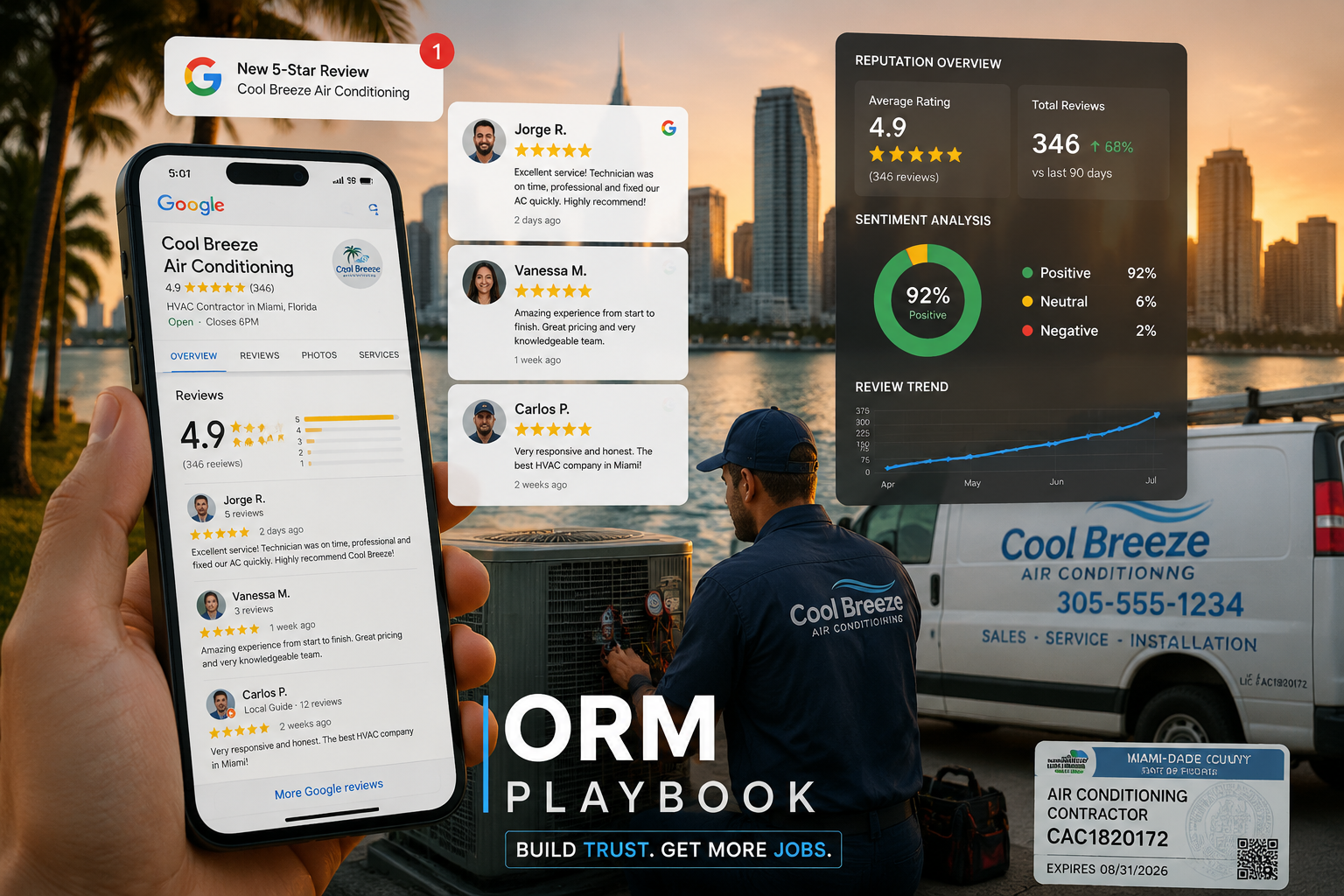
Online Reputation Management (ORM) for Home Services: A South Florida Contractor Playbook
Last updated: June 2, 2026
A single 1-star review on a Miami HVAC company's Google Business Profile can divert an estimated 21% of clicks to the competitor ranked directly below it (BrightLocal Local Consumer Review Survey, 2024). That's not a marketing problem. That's a revenue leak. And in a market like South Florida — where 4.7-star contractors are the floor, not the ceiling — online reputation management for home services is the single highest-leverage system a contractor can build in 2026.
This playbook is the field manual. It covers what ORM actually is, what it costs, what works for HVAC, plumbing, roofing, and electrical pros in Miami-Dade and Broward, and the autonomous systems that make all of it run while you're on the truck.
Quick Answer
Online reputation management for home services is the system contractors use to monitor, generate, respond to, and recover from online reviews and brand mentions — primarily on Google, Yelp, Facebook, and Nextdoor. For South Florida home service businesses, effective ORM blends automated review requests (sent within minutes of job completion), professional response protocols, Google Business Profile optimization, and AI-powered monitoring. Done right, it lifts star ratings, increases booked jobs by 30–50%, and protects against competitor sabotage. Done wrong — or ignored — it quietly hands leads to the contractor next door.
Key Takeaways
- ORM is a revenue system, not a marketing afterthought. Each star above 4.0 correlates with roughly 9% more clicks (Womply, 2023).
- South Florida's competitive density (Miami-Dade alone has 8,000+ licensed contractors) makes review velocity and recency more important than total review count.
- Automated review requests sent within 10 minutes of job completion convert 3–5x better than next-day requests.
- Negative reviews handled well can outperform no review at all — 89% of consumers read responses (BrightLocal, 2024).
- Ignoring bad reviews is the most expensive mistake in home services. Silence reads as guilt.
- AI tools now handle 80% of ORM work — monitoring, requesting, responding, and routing — for a fraction of agency retainers.
- Reputation recovery typically takes 60–120 days with a disciplined system; faking it triggers Google penalties.
What Exactly Is Online Reputation Management for Contractors?
Online reputation management for contractors is the active control of how your business appears across review platforms, search results, social mentions, and AI answer engines. For home services, it has four moving parts:
- Generation — Asking every customer for a review, every time, through automated SMS or email.
- Monitoring — Tracking new reviews, mentions, and ratings across Google, Yelp, Facebook, BBB, and Nextdoor in real time.
- Response — Replying to every review (positive and negative) within 24 hours using brand-consistent, professional language.
- Recovery — Resolving issues offline, requesting updates, and reporting fake or policy-violating reviews.
Traditional reputation work was reactive — a marketing manager checking Google once a week. The Business Operating System for 2026 flips that. AI agents monitor 24/7, route alerts instantly, and trigger response workflows the moment a review lands. For a deeper look at how this integrates with lead systems, see contractor marketing automation explained.
How Much Does ORM Cost for a Small Home Services Business?
For a small South Florida home service business, expect to invest between $99 and $997 per month depending on the level of automation and human management you need. Here's the realistic breakdown:
| Tier | Monthly Cost | What's Included | Best For |
|---|---|---|---|
| DIY + basic tool | $0–$50 | Manual review requests, free GBP, spreadsheet tracking | Solo operators under 20 jobs/month |
| Automated software | $97–$297 | Auto-review requests, monitoring, unified inbox, AI responses | 1–10 employees, 50–300 jobs/month |
| Full AI workforce | $497–$997 | Voice AI receptionist, autonomous review management, crisis protocols, multi-location | Established contractors scaling without overhead |
| Agency retainer | $1,500–$5,000 | Human-managed responses, content, GBP, SEO | Established brands with $2M+ revenue |
The math gets interesting fast. A roofing job averages $12,000 in South Florida. If automated ORM lifts your booking rate by even 5%, the system pays for itself with a single job. See the real cost of a home services CRM for a fuller ROI model.
$$\text{ROI} = \frac{(\text{Extra Jobs} \times \text{Avg Ticket}) - \text{ORM Cost}}{\text{ORM Cost}} \times 100$$
ORM vs. Traditional Marketing: Which Works Better for Home Services?
ORM consistently outperforms traditional marketing for home service businesses on a per-dollar basis, because reviews are the last thing a homeowner checks before calling. Traditional marketing creates awareness; ORM closes the deal.
- Traditional marketing (direct mail, billboards, radio): Builds top-of-funnel awareness. ROI is hard to measure. Typical CPL: $80–$250.
- Paid search + ORM: Reviews directly influence whether a Google Ads click becomes a call. Strong reviews can cut CPL by 30–40%.
- Pure ORM: Drives organic local pack rankings, Google Screened/Local Services Ads eligibility, and direct-search conversion.
Decision rule: If your Google Business Profile has fewer than 50 reviews or a rating below 4.5, pause ad spend and fix ORM first. Pouring traffic into a leaky bucket wastes budget.
How Do I Fix Negative Google Reviews for My Plumbing Company?
You don't "fix" a negative Google review by deleting it — you fix it by responding professionally, resolving the issue offline, and burying it under fresh positive reviews. Here's the playbook:
- Respond within 24 hours. Acknowledge, apologize where appropriate, and move the conversation offline. Never argue publicly.
- Resolve the underlying issue. Refund, redo, or follow up. Document it.
- Politely ask for an update. Once resolved, the customer can edit their review. About 1 in 3 will.
- Generate volume. Five new 5-star reviews drop the average impact of one 1-star review dramatically.
- Report policy violations. If the review is fake, off-topic, or from a non-customer, flag it through Google's review removal tool.
Sample response template:
"Hi [Name], thank you for the feedback. We take every concern seriously and would like to make this right. I'm [Owner Name], and I've sent you a direct message — please respond so we can resolve this immediately."
For the full removal playbook, see how to remove a fake Google review.
Best ORM Tools Specifically for Home Service Contractors
The best ORM tools for home service contractors combine automated review requests, unified inbox monitoring, and AI-powered responses in one platform. Generic ORM software wasn't built for the rhythm of a service business — same-day jobs, mobile techs, and Spanish-speaking customers.
What to look for:
- Trigger-based review requests that fire when a job is marked complete in the CRM
- SMS + email in one workflow (SMS converts 5–8x better)
- Bilingual templates for South Florida's market
- GBP integration for one-click responses
- Crisis alerts when ratings drop below threshold
Hawk Guru's reputation marketing automation handles all of this inside the same platform that runs the AI Receptionist and CRM. One Unified AI Ecosystem instead of five logins.
Is ORM Worth It for New Home Service Businesses in South Florida?
Yes — and arguably more so for new businesses than established ones. A new contractor in Miami starting at zero reviews is invisible. Without reviews, you can't run Google Local Services Ads, you won't appear in the local 3-pack, and homeowners won't trust the click.
For a new business, the first 90 days should focus on:
- Getting to 25+ Google reviews as fast as possible (every customer, every time)
- Maintaining a 4.7+ average
- Building review recency (Google weights recent reviews heavily)
- Claiming and optimizing the Google Business Profile
Choose ORM-first if you're new, under $500K revenue, and depend on inbound calls. Skip aggressive ORM if you're 100% subcontractor or commercial-only with no public-facing customer base.
Common ORM Mistakes Contractors Make When Managing Online Reviews
The most common ORM mistakes contractors make are also the most expensive. Avoid these:
- Buying reviews. Google's AI detects review velocity anomalies. Penalties include profile suspension.
- Ignoring negative reviews. Silence reads as guilt to every future homeowner reading them.
- Generic responses. "Thank you for your review!" copy-pasted 40 times signals laziness.
- Asking only happy customers. Selective requesting (review gating) violates Google's terms.
- Slow response times. Replies after 7+ days show neglect.
- Only chasing Google. Yelp, Facebook, BBB, and Nextdoor matter for specific demographics. See Yelp vs Google reviews for contractors.
- No system. Relying on memory or one office manager. The hustle is exhausting — and it doesn't scale.
How Long Does It Take to Improve My Online Reputation?
Realistic timeline: 60–120 days to move a rating meaningfully, assuming consistent review generation and response. Faster isn't credible, slower means the system isn't working.
| Timeframe | Expected Movement |
|---|---|
| 0–30 days | Setup, baseline audit, first 10–20 new reviews. Rating may not shift yet. |
| 30–60 days | 30–50 new reviews. Star rating starts moving 0.1–0.3 points. |
| 60–90 days | Visible local pack movement. Ad CTR improves. |
| 90–120 days | New baseline locks in. Bad legacy reviews are buried in recency. |
A contractor at 3.8 stars with 40 reviews can realistically hit 4.6 in 90 days by generating 60+ fresh 5-star reviews and responding to all legacy negatives.
Can ORM Help Me Get More Home Service Leads in Miami and Broward?
Yes — directly and measurably. In Miami-Dade and Broward, ORM impacts lead volume through three channels:
- Local Pack rankings. Google's local 3-pack heavily weights review count, rating, and recency. Top-3 placement drives 60%+ of clicks.
- Google Local Services Ads eligibility. "Google Screened" status requires strong reviews. Without it, you don't compete for the highest-intent leads.
- Conversion rate on existing traffic. Two contractors with identical Google Ads spend will see 30–50% different conversion rates based on review quality alone.
A roofing contractor in Hialeah who moves from 4.2 to 4.8 stars typically sees 40–60% more inbound calls from the same ad budget. Pair that with missed call text-back and you stop leaking the leads you finally earned.
What Happens If I Ignore Bad Online Reviews?
Ignoring bad online reviews is the single most expensive decision in home services marketing. Here's what actually happens:
- Conversion rate drops 15–30% on Google Business Profile traffic.
- Negative reviews compound. Other unhappy customers see the silence and pile on.
- Google rankings decline. Profiles with low response rates are deprioritized in the local pack.
- Local Services Ads disqualification. Google Screened requires active reputation management.
- Word-of-mouth poisoning. Homeowners screenshot bad reviews into neighborhood Facebook groups.
One unanswered 1-star review on a $2M revenue contractor can quietly cost $80,000–$150,000 in lost annual revenue. The fix is a response, sent today.
ORM Strategies That Actually Work for HVAC and Electrical Contractors
The ORM strategies that actually move the needle for HVAC and electrical contractors in South Florida share three traits: speed, specificity, and automation.
- Job-completion trigger. The moment a tech closes a ticket in the CRM, a review request fires by SMS within 10 minutes. Conversion rates run 25–40% vs. 5–8% for delayed requests.
- Tech-specific requests. "How did Carlos do today?" outperforms "How did we do?" by 2x.
- Photo capture. Techs uploading before/after photos in the request lifts review length and detail.
- Bilingual workflows. Spanish-language requests in Miami-Dade convert 30%+ higher with Hispanic customers.
- Negative-feedback diversion. Internal feedback forms catch dissatisfied customers before they post publicly (without gating Google — they still get the link).
- Seasonal pushes. Seasonal HVAC campaigns tied to post-storm or post-summer windows drive review volume spikes.
For electrical contractors specifically, licensing trust signals matter as much as reviews — pair both. See the best CRM for electrical contractors for integration playbooks.
How Do Customers Decide Which Home Service Pro to Hire Based on Online Reviews?
South Florida homeowners follow a predictable 7-second pattern when evaluating contractors on Google:
- Star rating — Filter: below 4.5 gets skipped.
- Review count — Trust threshold: 25+ reviews minimum, 100+ preferred.
- Recency — Most recent reviews scanned first. Reviews older than 6 months feel stale.
- Owner responses — Professionalism in responses heavily influences the decision.
- Specific keywords — "On time," "honest pricing," "clean," "explained everything."
- Photos — Reviews with photos build 3x more trust.
- Negative review handling — One 1-star with a thoughtful response actually builds trust.
The decision is mostly made before the customer ever clicks "Call." Your reputation does the selling. Your AI receptionist just has to close.
The 90-Day Hawk Guru ORM Implementation Checklist
A working playbook, not theory:
Days 1–14:
- Audit GBP, Yelp, Facebook, BBB profiles
- Connect CRM to review request automation
- Build job-completion trigger workflow
- Write 5 response templates (positive, negative, neutral, Spanish, English)
- Set up real-time review alerts to owner's phone
Days 15–45:
- Auto-request from every completed job
- Respond to every review within 24 hours
- Address legacy negatives with offline resolution offers
- Train techs on requesting reviews verbally
Days 46–90:
- Review monthly metrics: star rating, volume, response time
- Refine templates based on conversion data
- Flag and report policy-violating reviews
- Expand to Yelp and Facebook with same workflow
Conclusion: Reputation Is the New Sales Funnel
In South Florida home services, online reputation isn't marketing — it's revenue infrastructure. Every review request you don't send is a lead you'll never know you lost. Every unanswered 1-star is a competitor's next job.
The Business Operating System for 2026 makes ORM autonomous. Hawk Guru's Voice AI Receptionist answers calls in <5 seconds, the CRM triggers review requests within minutes of job completion, and AI handles 80% of responses with Hawk-eyed precision. Reclaim 20 hours a week. Stop leaking leads. Scale without the overhead.
Next steps:
- Audit your Google Business Profile today — count reviews, average rating, last response date.
- Pick a tier from the cost table above that matches your job volume.
- Book a demo and see the autonomous review system in action.
From lead to loyal client — and from 3.8 to 4.9 stars — the system runs itself.
Frequently Asked Questions
Can I pay someone to remove bad Google reviews?
No legitimate service can remove a real review. Anyone who claims to is selling fraud. You can only report policy violations and request removal through Google directly.
How often should I ask customers for reviews?
Once, immediately after job completion, with one polite follow-up 3 days later if no response. More than that feels like spam.
Are Yelp reviews still important for Miami contractors?
Less than Google, but still relevant for older demographics and certain niches (restaurants, cleaners). For HVAC and roofing, Google is 80% of the battle.
What's the ideal Google review response length?
2–4 sentences. Acknowledge, personalize, and offer next steps. Longer responses look defensive.
Should I offer discounts for reviews?
Never. It violates Google's terms and triggers profile penalties. Offer great service — that's the only incentive that's compliant.
How do I get reviews in Spanish?
Send your review request in Spanish to Spanish-speaking customers. Hawk Guru's bilingual automation handles this natively.
Can negative reviews actually help?
Yes. A profile with all 5-star reviews looks fake. A few thoughtful 4-star reviews and well-handled 1-stars build credibility.
What if a competitor leaves a fake review?
Report it through Google's review removal tool with documentation. Response time has improved significantly in 2025–2026.
Sources
- BrightLocal. (2024). Local Consumer Review Survey 2024. https://www.brightlocal.com/research/local-consumer-review-survey/
- Womply Research. (2023). The Impact of Online Reviews on Local Business Revenue.
- Google. (2024). Google Business Profile Review Policies. https://support.google.com/contributionpolicy
Meta title: ORM for Home Services: The South Florida Contractor Playbook
Meta description: South Florida contractor playbook for online reputation management. Costs, tools, fixes for bad reviews, and AI workflows that lift HVAC, plumbing & roofing ratings.
Tags: online reputation management home services, ORM contractors Florida, Google reviews Miami contractors, HVAC reputation South Florida, plumbing reviews Miami, review automation contractors, GBP optimization Miami, contractor ORM cost, fake review removal, South Florida contractor marketing, AI review management, Hawk Guru reputation