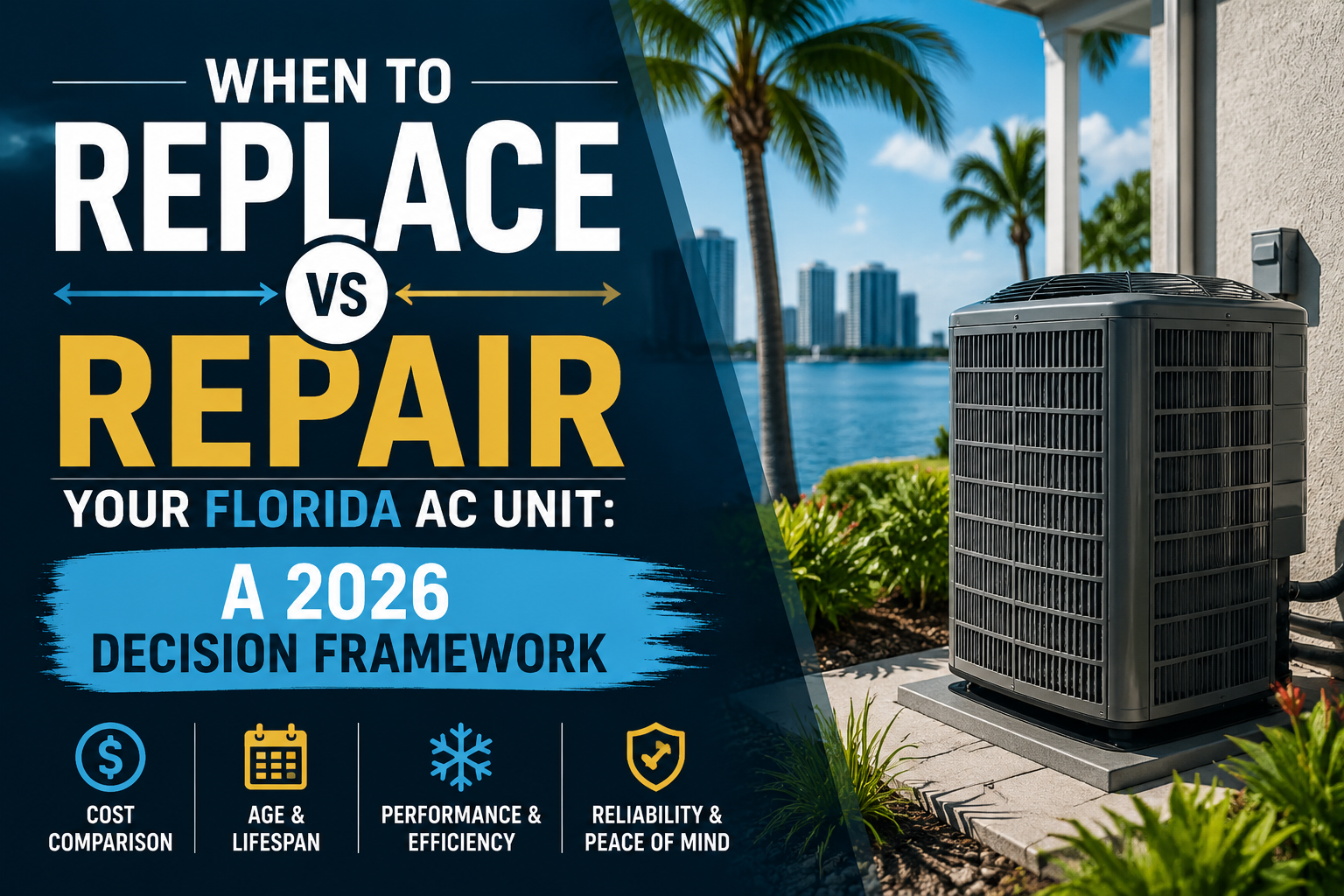
Updated May 2026 | Florida-specific | Reviewed by licensed contractors in our network
Florida AC units work harder than almost any residential cooling equipment in the country. The average central air system in Tampa or Miami runs 10–12 months per year — compared to 4–6 months in most northern states. That's not a minor difference. That's a unit aging at roughly twice the rate, under constant humidity, salt air, and heat loads that push compressors and coils to their limits daily.
Here's what that means in practice: a Florida AC unit that's 10 years old has already logged the equivalent wear of a 15–18-year-old system in a cooler climate. When yours starts acting up, the repair-or-replace question isn't just about this month's repair bill. It's about whether you're pouring money into a system that's statistically near the end of its useful life — in a state where a failed AC isn't a discomfort, it's a health risk.
Make the wrong call and you're looking at $400–$1,200 in repairs today, followed by a full replacement in 18 months anyway. Or you replace prematurely and leave $3,000–$5,000 in remaining value on the table. Neither outcome is good.
Why Florida's Climate Changes the Repair vs Replace Math
Florida's heat and humidity don't just make your AC work harder — they accelerate the failure of specific components in ways that shift the repair-or-replace calculus significantly.
Compressors fail earlier. In Miami and Fort Lauderdale, where outdoor temperatures exceed 90°F for five or more months, compressors run near their rated capacity for extended periods. Most HVAC manufacturers design compressors for a 15-year lifespan under moderate use. In South Florida, real-world compressor life often runs 10–12 years.
Coil corrosion is a coastal reality. Homes within 3–5 miles of the coast — which covers large portions of Sarasota, Naples, Fort Lauderdale, and Miami Beach — face accelerated evaporator and condenser coil corrosion from salt air.
Energy costs amplify the efficiency argument. A 10-year-old unit running at 10 SEER costs significantly more to operate than a modern 16–20 SEER system — and Florida's long cooling season means that gap adds up fast.
The 2026 Decision Framework
Step 1: Apply the 5,000 Rule
Multiply your system's age (in years) by the estimated repair cost. If the result exceeds $5,000, replacement is almost always the smarter financial move.
Example: Your unit is 9 years old. The repair quote is $650. 9 × $650 = $5,850 → Replace.
Example: Your unit is 5 years old. The repair quote is $400. 5 × $400 = $2,000 → Repair.
Step 2: Check System Age Against Florida Benchmarks
| System Age | Florida Recommendation |
|---|---|
| Under 8 years | Repair, unless compressor failure |
| 8–12 years | Evaluate with the 5,000 Rule |
| 12–15 years | Lean toward replacement |
| 15+ years | Replace — don't invest further |
Step 3: Identify the Failing Component
Repair is usually worth it:
- Capacitor or contactor failure ($150–$350)
- Refrigerant recharge on a newer system ($200–$500)
- Thermostat replacement ($100–$300)
- Condensate drain cleaning or repair ($75–$200)
Replacement becomes the better call:
- Compressor failure on a unit over 8 years old ($1,200–$2,500 to repair)
- Evaporator coil failure on a unit over 10 years old ($900–$2,000 to repair)
- Refrigerant leak on an R-22 system (R-22 is phased out; recharging is expensive and temporary)
Step 4: Factor in SEER Rating and Energy Costs
If your current system is rated below 14 SEER, replacing it with a modern 16–20 SEER unit will meaningfully reduce your monthly electric bill. Upgrading from 10 SEER to 18 SEER can reduce cooling costs by 30–45% annually.
AC Replacement Costs by Florida City (2026, Full System)
| City | 2-Ton System | 3-Ton System | 4-Ton System |
|---|---|---|---|
| Tampa | $4,200–$6,800 | $5,200–$8,200 | $6,500–$10,000 |
| Miami | $4,500–$7,200 | $5,500–$8,800 | $7,000–$10,800 |
| Orlando | $4,000–$6,500 | $5,000–$7,800 | $6,200–$9,500 |
| Jacksonville | $3,800–$6,200 | $4,800–$7,500 | $6,000–$9,200 |
| Fort Lauderdale | $4,500–$7,200 | $5,500–$8,800 | $7,000–$10,800 |
| Naples | $4,400–$7,000 | $5,400–$8,500 | $6,800–$10,500 |
Red Flags When Hiring an HVAC Contractor in Florida
- They recommend replacement without a written diagnostic report.
- They can't provide a Florida HVAC contractor license number (verify at myfloridalicense.com).
- They offer to skip the permit — a disqualifying red flag.
- The quote is verbal only.
- They push an unknown brand at an unusually low price.
- They can't show proof of insurance.
- They pressure you to decide immediately.
The Best Time of Year to Replace Your Florida AC
Peak demand (May–September): Highest prices, longest lead times. Avoid if planning ahead.
Best window (October–February): Highest contractor availability, prices 5–15% lower.
Second-best (March–April): Before the summer rush — act here if your unit struggled last summer.
Conclusion: Make the Call With Confidence
Apply the 5,000 Rule, check your system's age against Florida-specific benchmarks, identify the failing component, and factor in your SEER rating and energy costs. Those four steps eliminate most of the uncertainty. Always verify your contractor's Florida DBPR license before signing anything.