SUGGESTED URL SLUG: verify-florida-contractor-license
SEO TITLE: Verify a Florida Contractor's License in 60 Seconds
META DESCRIPTION: Learn how to verify a Florida contractor's license in under 60 seconds using the DBPR database — and spot the spring scams before they cost you thousands.
How to Verify a Florida Contractor's License in Under 60 Seconds (And Avoid Spring Scams)
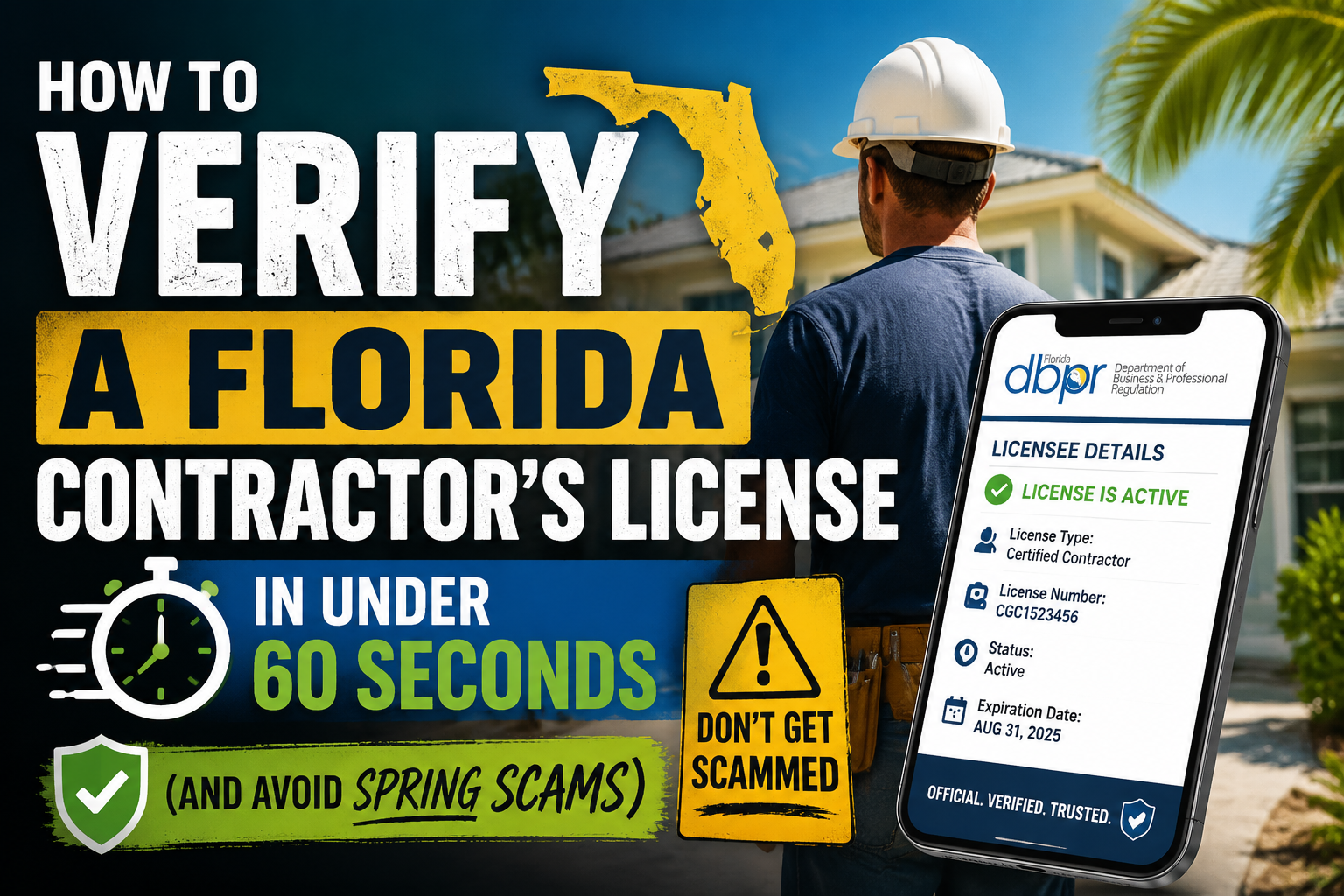
Updated May 2026 | Florida-specific | Reviewed by licensed contractors in our network
Quick Answer: Go to the Florida Department of Business and Professional Regulation (DBPR) license verification portal at myfloridalicense.com, type in the contractor's name or license number, and hit search. The result loads in seconds and tells you whether the license is active, expired, or suspended. That's the whole process — and it's free.
Key Takeaways
- The DBPR online portal lets you verify any Florida contractor's license in under 60 seconds, at no cost.
- Florida law requires general contractors, roofing contractors, electrical contractors, and plumbers to hold a state-issued license — not just a county business permit.
- Spring is peak season for unlicensed contractor scams in Tampa, Orlando, Fort Lauderdale, and across South Florida — especially after storm damage.
- An unlicensed contractor can void your homeowner's insurance claim and leave you personally liable for injuries on your property.
- "Licensed and insured" is not the same as "verified." Always check the DBPR yourself — don't take a contractor's word for it.
- County-level licenses (like Miami-Dade's Certificate of Competency) exist alongside state licenses. You may need to verify both.
- Red flags include requests for large cash deposits upfront, no physical business address, and pressure to skip permits.
- FL Services Hub lists verified Florida pros across all major trades — each listing is manually reviewed before going live.
What's in this guide:
- Why Spring Is Prime Time for Contractor Fraud in Florida
- How to Verify a Florida Contractor's License in Under 60 Seconds — Step by Step
- State License vs. County Certificate: What's the Difference?
- What Florida Insurance Carriers Actually Expect
- Red Flags That Should End the Conversation
- The Spring Hiring Timeline: When to Book, When to Wait
- Frequently Asked Questions
- How to Find Verified Florida Contractors Without the Guesswork
Spring arrives in Florida before most of the country even puts away their winter coats. That's good news for your landscaping project — and very good news for unlicensed contractors looking for their next mark.
Why Spring Is Prime Time for Contractor Fraud in Florida {#why-spring}
Florida's spring home improvement surge creates the perfect conditions for contractor fraud. Homeowners are motivated, budgets are loosening after the holidays, and demand for roofing, HVAC, painting, and remodeling work spikes sharply between March and June — before hurricane season forces everyone to scramble.
That surge in demand is exactly what unlicensed operators count on.
According to the Florida Department of Business and Professional Regulation, the agency fields tens of thousands of unlicensed activity complaints annually. Roofing and general contracting consistently rank among the most-reported trades. And the complaints spike in spring and again after named storms — when homeowners are eager, distracted, or both.
The financial damage is real. Homeowners who hire unlicensed contractors in Florida can face:
- Voided insurance claims — most Florida homeowner policies require work to be performed by licensed contractors for coverage to apply.
- Failed permit inspections — work done without permits (or by unlicensed workers) often has to be torn out and redone at the homeowner's expense.
- Personal liability — if a worker is injured on your property and the contractor carries no workers' compensation insurance, you may be sued directly.
- No legal recourse — Florida's Construction Industries Licensing Board can discipline licensed contractors. Unlicensed ones? There's no board to complain to.
In Tampa, Miami, Jacksonville, and Fort Lauderdale, the spring market moves fast. Homeowners feel pressure to book before slots fill up. That urgency is exactly what scam contractors exploit — and knowing how to verify a Florida contractor's license in under 60 seconds is the single fastest way to protect yourself.
How to Verify a Florida Contractor's License in Under 60 Seconds — Step by Step {#how-to-verify}
The DBPR online portal is the authoritative source for Florida contractor license verification. It's free, public, and updated in real time. Here's exactly how to use it.
Step 1: Go to the DBPR Verification Portal
Navigate to myfloridalicense.com/wl11.asp — or search "Florida DBPR license verification" and click the official state government result.
Step 2: Choose Your Search Method
You can search by:
- Contractor name (first and last, or business name)
- License number (if the contractor has provided one)
- City (useful for browsing licensed pros in a specific area)
If the contractor gave you a license number, use that. It's the fastest and most accurate search.
Step 3: Review the Results
The portal returns:
| Field | What to Look For |
|---|---|
| License Status | Must say "Current, Active" — anything else is a problem |
| License Type | Confirm it matches the work being done (e.g., Roofing Contractor, not General Contractor) |
| Expiration Date | Should be future-dated |
| Qualifier Name | The individual legally responsible for the license |
| Counties Authorized | Some licenses are county-specific |
Step 4: Cross-Check the Business Name
The name on the DBPR record should match the business name on the contractor's estimate, truck, and business card. Mismatches are a red flag — not necessarily fraud, but worth asking about directly.
Step 5: Ask for Proof of Insurance
License verification confirms the contractor is legally authorized to work. It does not confirm they carry liability insurance or workers' compensation. Ask for a Certificate of Insurance and call the issuing insurance company to verify it's current.
That's it. Five steps, under 60 seconds for steps 1–4. This is how to verify a Florida contractor's license in under 60 seconds — and it works for every trade from roofing in Miami-Dade to plumbing in Tampa to electrical work in Orlando.
Want to skip the verification step entirely? Every contractor listed on FL Services Hub has been manually reviewed before their listing goes live. Get free quotes from verified Florida pros →
State License vs. County Certificate: What's the Difference? {#state-vs-county}
Florida has two parallel licensing systems, and confusing them is one of the most common mistakes homeowners make. Understanding which applies to your project can save you a significant headache.
State-Certified Contractors
A state-certified license is issued by the DBPR and is valid statewide. These contractors passed a state exam and meet statewide standards. State certification is required for:
- General contractors
- Roofing contractors
- Electrical contractors (EC license)
- Plumbing contractors
- HVAC contractors (CAC license)
- Underground utility contractors
These are the trades where mistakes carry the highest safety and structural risk — which is why Florida mandates statewide oversight.
State-Registered (County) Contractors
A state-registered contractor holds a county or municipal Certificate of Competency — meaning they passed a local exam and are registered with the state, but their authorization is limited to specific counties.
This matters in markets like Miami-Dade and Broward County, which have their own robust local licensing systems. A contractor licensed in Miami-Dade may not be authorized to work in Palm Beach County without additional registration.
How to Tell the Difference
On the DBPR portal, look at the license prefix:
- "CG" or "CBC" = Certified General Contractor (statewide)
- "RG" = Registered General Contractor (county-limited)
- "CAC" = Certified AC Contractor (statewide)
- "EC" = Certified Electrical Contractor (statewide)
If you're in a county with its own licensing board — Miami-Dade, Broward, Palm Beach — verify with both the DBPR and the county's contractor licensing division.
What Florida Insurance Carriers Actually Expect {#insurance}
Florida's homeowner insurance market is one of the most scrutinized in the country, and unlicensed contractor work is a documented basis for claim denial. This isn't hypothetical — it's written into most Florida policy language.
Here's what most Florida insurance carriers expect when work is performed on a covered property:
- Licensed contractors for any structural, electrical, plumbing, or roofing work
- Pulled permits for work that requires them under Florida Building Code
- Passed inspections — especially for roofing, which affects wind mitigation ratings
- Documentation — keep the contractor's license number, insurance certificate, and permit numbers on file
The Permit Issue Is Bigger Than Most Homeowners Realize
Unpermitted work doesn't just risk your insurance coverage — it creates a title problem. When you sell your home, unpermitted work must be disclosed. Buyers' inspectors flag it. Lenders sometimes won't finance a home with open or failed permits.
In Sarasota and Naples, where property values are high and buyer scrutiny is intense, unpermitted roofing or electrical work has derailed closings.
The fix is simple: ask your contractor to pull the permit before work begins. In Florida, it is the contractor's legal responsibility to pull permits — not the homeowner's. If a contractor asks you to pull the permit yourself, that's a serious red flag.
For HVAC work specifically, Florida requires permits for new installations and replacements. An HVAC system installed without a permit won't qualify for certain utility rebates and may affect your insurance wind mitigation report.
Comparing quotes for a spring project? Get 3 free quotes from verified Florida contractors in your city →
Red Flags That Should End the Conversation {#red-flags}
Some warning signs are subtle. Others are obvious. Here are the ones that should stop a hiring conversation in its tracks — regardless of how good the price sounds.
🚩 They Can't Provide a License Number Immediately
Any legitimate Florida contractor knows their license number by heart. If they hesitate, say they "left it at the office," or offer to send it later — verify before you sign anything.
🚩 They Ask for a Large Cash Deposit Upfront
Florida law limits contractor deposits on residential projects. For projects over $2,500, a contractor cannot legally require more than 10% upfront — or the cost of special-order materials, whichever is greater. Requests for 50% or more upfront, in cash, are a major warning sign.
🚩 They Approach You After a Storm
"Storm chasers" — unlicensed contractors who flood neighborhoods after hurricanes or heavy rain — are a documented problem across Jacksonville, Fort Lauderdale, and coastal communities. Legitimate contractors don't knock on doors uninvited after weather events.
🚩 No Physical Business Address
A P.O. box or a phone number with no verifiable address is not enough. Check Google Maps. Look for a real business location. If the company has no traceable address, there's no accountability.
🚩 They Pressure You to Skip the Permit
This is perhaps the clearest sign of an unlicensed or underqualified operator. No legitimate contractor pressures homeowners to skip permits. Permits protect you — not the contractor.
🚩 The Quote Is Dramatically Lower Than Others
Three quotes for a roof replacement come in at $18,000, $19,500, and $9,200. The outlier isn't a deal — it's a signal. Either the scope is different, the materials are inferior, or the contractor isn't licensed and insured (and therefore has lower overhead).
🚩 No Written Contract Before Work Begins
Florida law requires written contracts for residential construction projects over $2,500. A contractor who resists putting terms in writing is a contractor you should not hire.
For home improvement projects of any size, the contract should specify scope, materials, payment schedule, start and completion dates, and license number.
The Spring Hiring Timeline: When to Book, When to Wait {#timing}
Spring in Florida runs from roughly February through May — and it's the single best window to hire for most home improvement projects. Here's why timing matters, and how to use it to your advantage.
February–March: Book Now for Summer Projects
Tampa, Orlando, and St. Petersburg homeowners who want work completed before hurricane season (June 1) should be getting quotes in February and March. Roofing, HVAC replacement, and major remodeling projects book out 6–10 weeks during peak season.
April–May: Last Call for Pre-Hurricane Season Work
By late April, contractor calendars in South Florida fill fast. If you're in Miami or Fort Lauderdale and need roofing, structural repairs, or window replacements before storm season, April is your last comfortable window.
June–November: Hurricane Season Complications
Work can still happen during hurricane season, but scheduling is unpredictable, material prices can spike after named storms, and insurance inspections may be delayed. For non-urgent projects, waiting until December is often smarter.
December–January: Off-Season Advantages
This is when negotiating power shifts to homeowners. Demand drops, contractor availability improves, and some trades offer off-season pricing. For landscaping, painting, and interior remodeling, winter is an underrated window.
| Season | Best For | Watch Out For |
|---|---|---|
| Feb–Mar | Booking roofing, HVAC, major remodels | Slots fill fast — don't delay |
| Apr–May | Last pre-hurricane window | Scam contractors peak here |
| Jun–Nov | Urgent repairs only | Storm chasers, price spikes |
| Dec–Jan | Interior work, landscaping, painting | Some trades have limited crews |
Frequently Asked Questions {#faq}
Q: Is the DBPR license verification portal free to use?
Yes. The Florida DBPR's online license verification tool at myfloridalicense.com is completely free for consumers. You don't need to create an account or provide any personal information to search.
Q: What if a contractor's license shows as "Delinquent" or "Null and Void"?
Do not hire them for licensed work. A delinquent license means the contractor failed to renew on time. "Null and Void" means the license has been terminated. In both cases, the contractor is not legally authorized to perform licensed contracting work in Florida.
Q: Can a homeowner pull their own permit in Florida?
Yes — Florida law allows homeowners to pull permits for work on their own primary residence. However, this means you take on legal responsibility for the work meeting code. If you hire a contractor, the permit should be in the contractor's name, not yours.
Q: Does a Florida contractor's license cover all counties?
State-certified licenses are valid statewide. State-registered licenses are county-specific. Always confirm the contractor's authorization covers the county where your project is located — especially in Miami-Dade, Broward, and Palm Beach.
Q: What's the difference between a licensed contractor and a licensed and insured contractor?
A license confirms legal authorization to perform the work. Insurance (liability and workers' compensation) protects you if something goes wrong — property damage, injuries, incomplete work. You need both. Always request a Certificate of Insurance and verify it directly with the insurer.
Q: How do I report an unlicensed contractor in Florida?
File a complaint with the DBPR at myfloridalicense.com, or call 850-487-1395. For criminal activity (fraud, theft), contact local law enforcement. The DBPR can investigate, issue fines, and refer cases to the state attorney's office.
Q: Are handymen required to be licensed in Florida?
It depends on the work. Florida exempts "minor repairs" from licensing requirements, but there's no precise dollar threshold that defines "minor." Any structural, electrical, plumbing, roofing, or HVAC work requires a licensed contractor regardless of scope. When in doubt, verify.
Q: What should a legitimate contractor's quote include?
At minimum: contractor's name, license number, business address, scope of work, materials specified, payment schedule, start and estimated completion dates, and permit responsibility. Missing any of these is worth asking about before signing.
How to Find Verified Florida Contractors Without the Guesswork {#directory}
Knowing how to verify a Florida contractor's license in under 60 seconds is a skill every homeowner should have. But there's a faster path: working from a directory where the verification has already been done.
FL Services Hub is a Florida-focused home services directory built specifically for homeowners in Tampa, Miami, Orlando, Jacksonville, Fort Lauderdale, Naples, Sarasota, and St. Petersburg. Every contractor listed on the platform is manually reviewed before their listing goes live — not algorithmically approved, not self-reported.
What that means for you:
- License status confirmed before the listing is published
- Service area verified — no out-of-county contractors claiming local coverage
- Real business information — physical address, contact details, trade categories
- Homeowner reviews from actual Florida clients
The directory covers every major trade: roofing, HVAC, plumbing, electrical, pest control, landscaping, home improvement, and more.
If you're ready to move on a spring project, you can request free quotes from verified Florida contractors in your city right now. No obligation, no sales pressure — just real Florida pros who've already cleared the licensing bar.
Conclusion
Verifying a Florida contractor's license takes less time than it takes to read this sentence twice. The DBPR portal is free, accurate, and available 24/7. There's no excuse — and no reason — to skip this step before handing over a deposit.
Spring is when the Sunshine State's home improvement market heats up, and it's also when unlicensed operators are most active. The combination of motivated homeowners, high demand, and post-storm urgency creates real risk. A 60-second license check, a request for a Certificate of Insurance, and a written contract before work begins will protect you from the vast majority of contractor fraud scenarios.
Your next step: before you sign anything this spring, run the contractor's name or license number through myfloridalicense.com. If you want to start with contractors who've already been vetted, browse verified Florida pros on FL Services Hub — and get your project moving on solid ground.
References
- Florida Department of Business and Professional Regulation. License Verification Portal. myfloridalicense.com. (Accessed 2026)
- Florida Statutes, Chapter 489 — Contracting. Construction Licensing Requirements. leg.state.fl.us. (2023)
- Florida Building Commission. Florida Building Code, 8th Edition. floridabuilding.org. (2023)
- Florida Department of Financial Services. Consumer Guide to Homeowner's Insurance. myfloridacfo.com. (2024)
Tags: Florida contractor license verification, unlicensed contractor scams, DBPR license check, Florida home services, spring contractor fraud, licensed and insured Florida, roofing contractor Florida, Florida building permits, homeowner protection Florida, contractor red flags, FL Services Hub, Florida DBPR
<script type="application/ld+json">
{
  "@context": "https://schema.org",
  "@type": "FAQPage",
  "mainEntity": [
    {
      "@type": "Question",
      "name": "Is the DBPR license verification portal free to use?",
      "acceptedAnswer": {
        "@type": "Answer",
        "text": "Yes. The Florida DBPR's online license verification tool at myfloridalicense.com is completely free for consumers. You don't need to create an account or provide any personal information to search."
      }
    },
    {
      "@type": "Question",
      "name": "What if a contractor's license shows as 'Delinquent' or 'Null and Void'?",
      "acceptedAnswer": {
        "@type": "Answer",
        "text": "Do not hire them for licensed work. A delinquent license means the contractor failed to renew on time. 'Null and Void' means the license has been terminated. In both cases, the contractor is not legally authorized to perform licensed contracting work in Florida."
      }
    },
    {
      "@type": "Question",
      "name": "Can a homeowner pull their own permit in Florida?",
      "acceptedAnswer": {
        "@type": "Answer",
        "text": "Yes — Florida law allows homeowners to pull permits for work on their own primary residence. However, this means you take on legal responsibility for the work meeting code. If you hire a contractor, the permit should be in the contractor's name, not yours."
      }
    },
    {
      "@type": "Question",
      "name": "Does a Florida contractor's license cover all counties?",
      "acceptedAnswer": {
        "@type": "Answer",
        "text": "State-certified licenses are valid statewide. State-registered licenses are county-specific. Always confirm the contractor's authorization covers the county where your project is located — especially in Miami-Dade, Broward, and Palm Beach."
      }
    },
    {
      "@type": "Question",
      "name": "What's the difference between a licensed contractor and a licensed and insured contractor?",
      "acceptedAnswer": {
        "@type": "Answer",
        "text": "A license confirms legal authorization to perform the work. Insurance (liability and workers' compensation) protects you if something goes wrong — property damage, injuries, incomplete work. You need both. Always request a Certificate of Insurance and verify it directly with the insurer."
      }
    },
    {
      "@type": "Question",
      "name": "How do I report an unlicensed contractor in Florida?",
      "acceptedAnswer": {
        "@type": "Answer",
        "text": "File a complaint with the DBPR at myfloridalicense.com, or call 850-487-1395. For criminal activity such as fraud or theft, contact local law enforcement. The DBPR can investigate, issue fines, and refer cases to the state attorney's office."
      }
    },
    {
      "@type": "Question",
      "name": "Are handymen required to be licensed in Florida?",
      "acceptedAnswer": {
        "@type": "Answer",
        "text": "It depends on the work. Florida exempts minor repairs from licensing requirements, but any structural, electrical, plumbing, roofing, or HVAC work requires a licensed contractor regardless of scope. When in doubt, verify through the DBPR portal."
      }
    },
    {
      "@type": "Question",
      "name": "What should a legitimate contractor's quote include?",
      "acceptedAnswer": {
        "@type": "Answer",
        "text": "At minimum: contractor's name, license number, business address, scope of work, materials specified, payment schedule, start and estimated completion dates, and permit responsibility. Missing any of these is worth asking about before signing."
      }
    }
  ]
}
</script>