AI Receptionist vs Human Receptionist for Home Service Companies: Which Wins in 2026?
Last updated: June 2, 2026
A Miami HVAC owner ran a 30-day test last spring: half his inbound calls went to his front-desk hire, half went to a Voice AI Receptionist. The AI booked 42% more jobs, answered in under 5 seconds, and never took a lunch break. His human receptionist? Quit three weeks in to start her own cleaning company.
This is the 2026 reality of the AI receptionist vs human receptionist debate for home service companies in Miami and Tampa. Below is the full breakdown — costs, accuracy, edge cases, and the hybrid playbook that wins.
Quick Answer
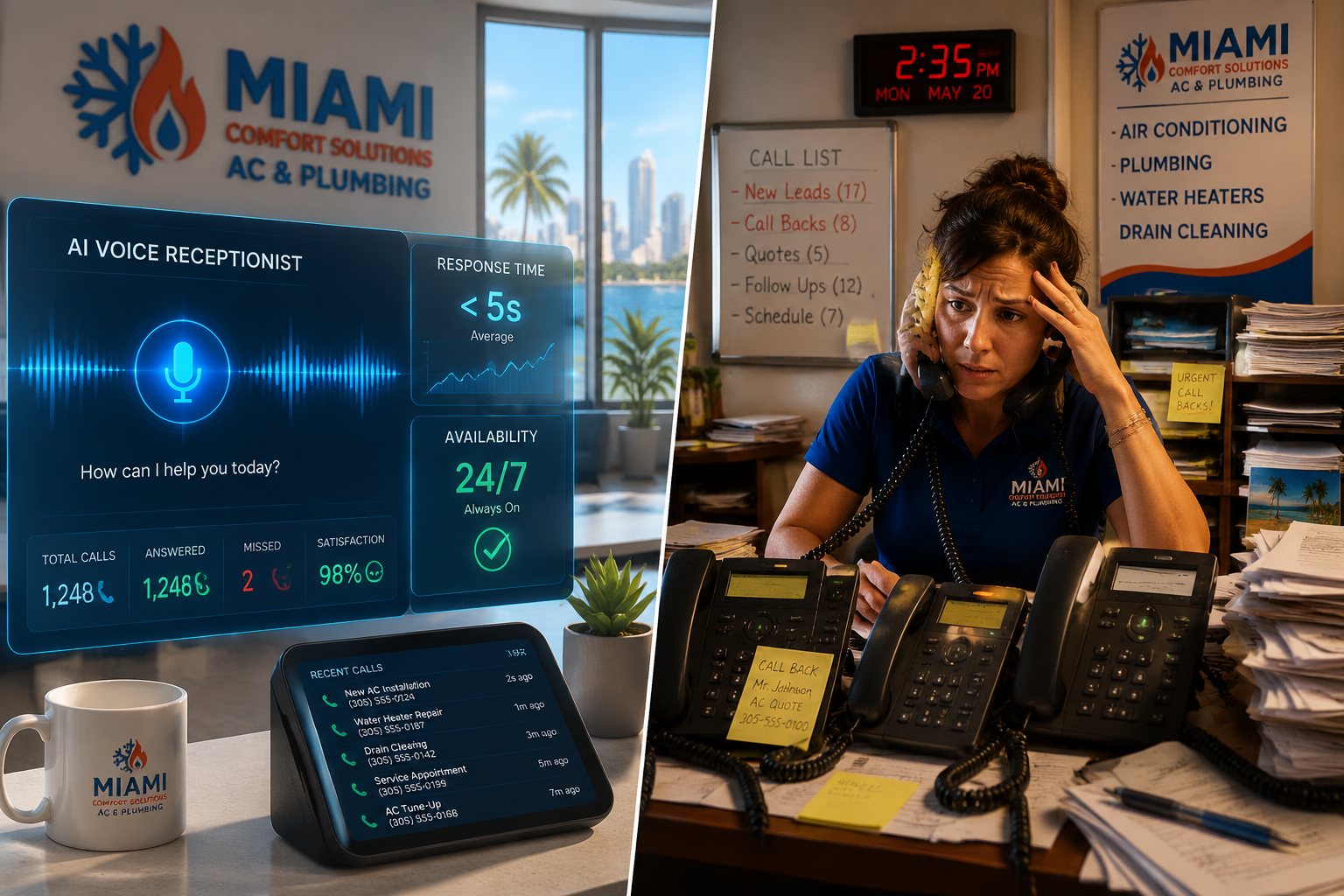
For most home service businesses in Miami and Tampa with 1–25 employees, an AI Receptionist wins on cost, speed, and 24/7 coverage, while a human still wins on complex emotional triage. The smartest operators in 2026 run a hybrid model: AI answers 100% of calls instantly, then transfers the 5–10% of truly complex situations to a human. That setup books more jobs, costs ~80% less than a full-time receptionist, and stops leaking after-hours leads.
Key Takeaways
- AI receptionists cost ~$200–$1,000/month vs $3,500–$5,500/month for a full-time human receptionist in South Florida.
- Response time gap is brutal: AI answers in <5 seconds, 24/7. Humans miss 30–50% of after-hours calls.
- Accuracy on scheduling: Modern Voice AI books appointments correctly 92–97% of the time when integrated properly with your CRM.
- Best fit: HVAC, roofing, plumbing, electrical, landscaping, junk removal, and pest control in Miami-Dade, Broward, and Hillsborough counties.
- Hybrid beats either-or: AI handles volume + speed, human handles complaints and high-ticket consultations.
- Bilingual coverage: AI handles 30+ languages including Cuban Spanish accents natively — critical in Miami.
- Biggest mistake: Plugging in an AI receptionist without a CRM and call routing logic. You'll book ghosts.
- Compliance matters: Florida is a two-party consent state for recording. Your AI must disclose.
How much cheaper is an AI receptionist compared to a human?
An AI receptionist costs roughly 80–90% less than a full-time human receptionist. In Miami and Tampa, a competent bilingual front-desk hire runs $18–$26/hour plus payroll tax, benefits, and PTO — about $45,000–$60,000/year fully loaded. A Voice AI Receptionist runs $200–$1,000/month depending on call volume and feature depth.
Here's the math for a typical 10-employee Miami HVAC company:
| Cost Factor | Human Receptionist | AI Receptionist |
|---|---|---|
| Monthly base cost | $4,200 | $397–$997 |
| Coverage hours | 40/week | 168/week (24/7) |
| Calls handled simultaneously | 1 | Unlimited |
| Sick days / PTO | 15–20 days/year | 0 |
| Training cost | $2,000+ | Included |
| Annual total | ~$55,000 | ~$8,000 |
$Annual\ Savings = $55{,}000 - $8{,}000 = $47{,}000$
That's before counting recaptured after-hours leads. See the full AI vs human receptionist cost comparison for line-item breakdowns.
Can AI receptionists handle complex customer service situations?
AI receptionists handle 85–95% of typical home service calls flawlessly — booking, rescheduling, quoting basic service ranges, capturing lead info, and routing emergencies. They struggle with emotionally loaded complaints, multi-party disputes, and ambiguous insurance claims. For those, a smart system uses live call transfer to a human.
AI handles well:
- "I need AC repair, when can someone come?"
- "Reschedule my Tuesday plumber to Thursday."
- "Do you service Coral Gables?"
- "What's the estimate for a 3-ton condenser swap?"
Hand off to a human when:
- Customer is screaming about a botched job
- Insurance adjuster needs documentation discussion
- Custom commercial bid with 12 variables
- Legal threats or chargeback disputes
The rule we give Miami and Tampa clients: AI takes the 95% so your human can actually win the 5% that matter.
What home service industries benefit most from AI receptionists?
The industries with the highest ROI from AI receptionists are those with high call volume, emergency demand, and seasonal spikes. In South Florida, that's a long list.
Top winners:
- HVAC — Brutal summer call spikes in Miami and Tampa. 24/7 AI call answering for HVAC catches every AC-down emergency.
- Plumbing — Pipe bursts don't wait for business hours. After-hours AI call answering books overnight.
- Roofing — Storm season generates 3x volume surges. AI scales instantly.
- Electrical — Licensed-trade intake with code questions.
- Landscaping — Bilingual peak-season volume (March–October).
- Junk removal — Same-day booking is everything.
- Pest control — Recurring service confirmations.
Smaller niche operators like cleaning crews and painters also benefit, especially solo operators who can't answer while on a job.
Pros and cons of replacing human receptionists with AI
Pros:
- Instant <5-second response
- 24/7/365 coverage including holidays
- Unlimited simultaneous calls
- Zero turnover, zero training drift
- Native CRM integration and call analytics
- 30+ language support (huge in Miami)
- Costs 80% less
Cons:
- Less empathetic in true emotional moments
- Requires upfront setup (1–2 weeks)
- Needs clean call routing logic to perform
- Customers over 70 sometimes prefer a human voice
- Edge-case conversations may need handoff
The honest take: AI doesn't replace receptionists — it replaces the frustrating parts of receptionist work and lets humans focus on revenue-protecting interactions.
Do customers prefer talking to a human or an AI receptionist?
Most homeowners in 2026 don't care — they prefer whichever answers faster and solves their problem. A 2024 Pew Research study on AI in customer service found 60% of consumers under 50 are comfortable with AI agents for routine tasks. Modern Voice AI voices are nearly indistinguishable from human ones.
What homeowners actually want, in order:
- Someone (or something) picks up immediately
- The agent understands their problem
- They get a real appointment on the calendar
- They get a confirmation text
AI delivers all four. A human receptionist who misses the call delivers zero.
How accurate are AI receptionists at scheduling appointments?
Modern AI receptionists book appointments accurately 92–97% of the time when properly integrated with your CRM and calendar. Accuracy depends on three things: call clarity, calendar sync, and how well the AI was trained on your service area and pricing rules.
See how AI receptionists book appointments for the full workflow. Tight scheduling integration with Google Calendar, ServiceTitan, or HouseCall Pro is non-negotiable.
Common scheduling errors and fixes:
- Wrong timezone — fix with calendar config
- Booking outside service area — fix with zip-code rules
- Double-booking — fix with two-way calendar sync
What training is needed to implement an AI receptionist system?
Implementation takes 5–14 days for most home service companies. There's no "training" in the human sense — you configure the AI with your business logic. See the full AI receptionist training guide.
Setup checklist:
- Upload service list and pricing ranges
- Define service area (zip codes)
- Set business hours and emergency protocols
- Configure CRM and calendar integration
- Record custom greetings
- Set escalation rules (when to transfer to human)
- A2P SMS registration for missed call text-back
Will AI receptionists completely replace human receptionists by 2026?
No — and this is the visionary take most consultants get wrong. By 2026, AI handles the volume layer (90%+ of calls) while humans move up the value stack into customer success, dispatch coordination, and high-ticket sales. Pure replacement is the wrong frame. Hybrid is the winning model.
The home service companies dominating Miami and Tampa right now run lean: one human handling complex sales and disputes, one AI handling everything else. They've reclaimed 20 hours a week and scaled bookings without adding headcount.
What are the biggest mistakes companies make when switching to AI receptionists?
The biggest mistake is treating the AI like a standalone gadget instead of part of a Unified AI Ecosystem. Plugging in voice AI without CRM, calendar, and follow-up automation guarantees disappointment.
Top 7 mistakes:
- No CRM integration — leads go nowhere
- No missed-call text-back fallback
- Vague service area rules (booking jobs 2 hours away)
- No human escalation path
- Generic greeting that sounds robotic
- Skipping A2P SMS registration
- No call analytics review in week 1
Fix: deploy AI as part of a complete business operating system, not a bolt-on.
How do AI receptionists handle languages and accents?
Modern AI receptionists handle 30+ languages natively, including thick Cuban Spanish, Haitian Creole, Brazilian Portuguese, and Southern American English — all critical for the Miami and Tampa markets. See the bilingual AI receptionist guide.
Accent handling has improved dramatically. The AI detects language within the first sentence and switches automatically. For Miami contractors serving Hialeah, Little Havana, and Doral, this is non-negotiable — a Spanish-first AI often outperforms an English-only human receptionist.
Are AI receptionists good for small vs large home service companies?
Both, but for different reasons. Small shops (1–10 employees) use AI to replace the impossible task of one owner answering all calls. Larger operators (25+ employees) use AI to standardize call quality and scale without adding $200K in front-desk salaries.
| Company Size | Primary AI Benefit |
|---|---|
| 1–5 employees | Owner reclaims 20 hrs/week |
| 6–25 employees | Stop leaking after-hours leads |
| 26–100 employees | Standardize quality, reduce headcount |
| Multi-location | Centralized routing across markets |
For multi-location operators across South Florida, see AI receptionist for multi-location home service companies.
What cybersecurity risks come with AI receptionist technology?
The main risks are data interception, voice spoofing, and improper PII storage. Reputable AI receptionist platforms encrypt calls end-to-end, store data in SOC 2 compliant infrastructure, and offer HIPAA-compliant configurations when needed.
Florida-specific note: Florida is a two-party consent state. Your AI must disclose recording at call start. Compliant platforms handle this automatically.
Verify before signing:
- SOC 2 Type II certification
- End-to-end encryption
- TCPA-compliant SMS via A2P registration
- Florida two-party consent disclosure
- Data residency in US
The hybrid model: how Miami and Tampa winners actually run it
The best-performing home service companies don't pick AI or human. They run AI as the front line and a human as the escalation layer.
Workflow:
- Call comes in — AI answers in <5 seconds
- AI qualifies, books, or routes
- If complex/emotional → live transfer to owner or CSR
- Post-call: AI logs everything to CRM
- Automated follow-up sequence triggers
Result: +42% more booked appointments, $850/month in software savings, 20 hours/week reclaimed. That's the 24/7 Autonomous Agency in practice. Read the full breakdown on missed calls killing home service revenue.
FAQ
Is an AI receptionist worth it for a 2-person plumbing shop in Tampa?
Yes. Solo and 2-person shops benefit most because the owner is usually on a job when calls hit. AI captures those leads in <5 seconds.
Will customers know they're talking to AI?
Modern Voice AI sounds human. Most callers don't notice unless told. Reputable platforms disclose if asked.
Can AI handle emergency dispatch?
Yes — modern systems triage emergencies and route them to on-call techs. See how AI handles emergency calls.
What happens during a hurricane or outage in Florida?
AI runs on redundant cloud infrastructure with 99.99% uptime. It outperforms a human who can't get to the office.
How fast can I switch from my answering service?
Most Miami and Tampa contractors switch in 7–14 days, including A2P SMS approval.
Does AI work with my existing CRM?
Yes — integrations with most major home service CRMs are standard. See the CRM integration guide.
Can AI handle Spanish-speaking callers in Miami?
Natively, including Cuban, Colombian, and Venezuelan accents.
What if AI books a bad appointment?
Confirmation SMS and calendar sync catch 99% of errors. Owners can audit calls via call analytics dashboards.
Conclusion: which wins in 2026?
For home service companies in Miami and Tampa, the AI receptionist wins on cost, speed, coverage, and consistency. The human receptionist still wins on emotional triage and complex sales conversations. The hybrid model wins on everything that matters: revenue, margin, and owner sanity.
Next steps:
- Audit your missed calls from the last 30 days
- Calculate lost revenue (missed calls × avg job value × close rate)
- Pilot a Voice AI Receptionist for 30 days against your current setup
- Measure booked appointments, response time, and customer feedback
- Lock in the hybrid model that fits your team
Stop leaking leads. Reclaim 20 hours a week. Scale without the overhead. That's the Business Operating System for 2026 — and it's how the best contractors in South Florida are pulling ahead right now.
Ready to test it? Book a demo with Hawk Guru and see your AI receptionist live on the call.
Sources
- Pew Research Center (2024). Public Awareness of Artificial Intelligence in Everyday Activities. https://www.pewresearch.org
- U.S. Bureau of Labor Statistics (2024). Occupational Employment and Wages: Receptionists. https://www.bls.gov/oes/
- Florida Statutes Chapter 934 (Two-Party Consent for Call Recording). https://www.flsenate.gov
Meta Title: AI vs Human Receptionist for Home Services: 2026 Winner
Meta Description: AI receptionist vs human receptionist for Miami and Tampa home service companies in 2026. Cost, accuracy, hybrid model breakdown. Stop missing calls.
Tags: AI receptionist, human receptionist comparison, HVAC answering service Miami, plumbing AI phone, Voice AI for contractors, home services automation, Tampa contractor CRM, missed call text back, bilingual receptionist Miami, 24/7 call answering, hybrid receptionist model, Hawk Guru