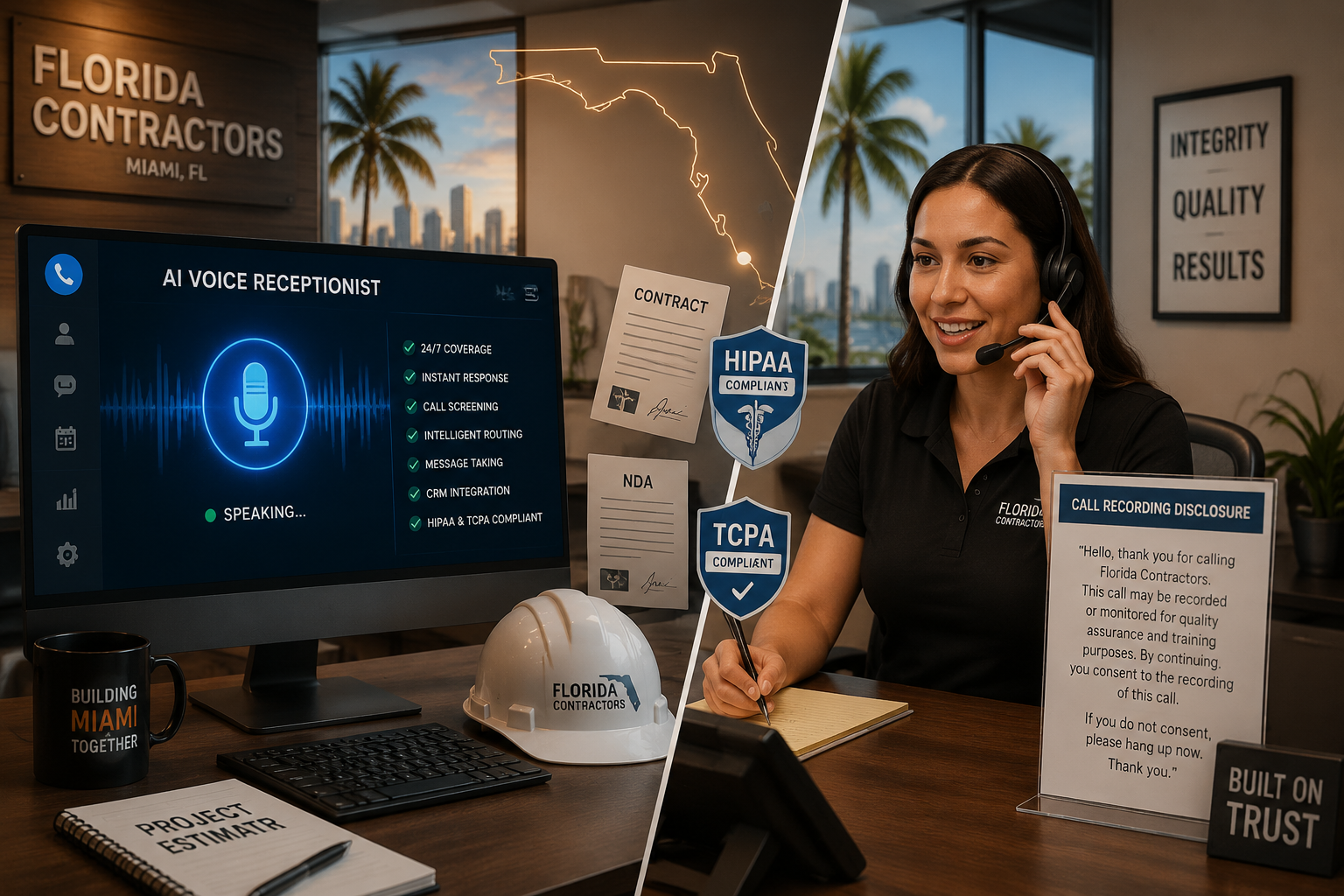
AI Receptionist vs Human Receptionist: Compliance & Recording Rules for Florida Contractor Calls | AI receptionist compliance Florida
Last updated: June 2, 2026
Quick Answer
Florida is a two-party consent state under Fla. Stat. § 934.03, meaning both the AI receptionist vs human receptionist debate hinges on the same rule: all parties must consent before a contractor call is recorded. AI receptionist compliance in Florida is fully achievable when the system delivers an automated disclosure at the start of every call, captures consent, and stores recordings under TCPA and Florida Telemarketing Act standards. Human receptionists carry the same legal obligation, but they fail it more often because disclosures get skipped under pressure.
Key Takeaways
- Florida is a two-party (all-party) consent state. Every party on the call must consent before recording begins, whether the receptionist is AI or human.
- AI receptionists deliver disclosures with 100% consistency. Human receptionists forget under volume; AI scripts never do.
- TCPA still applies to outbound AI calls and SMS — contractors need written consent for marketing outreach.
- Recording storage must be secured. Encryption, retention policies, and access controls are non-negotiable.
- Hybrid models work best: AI handles intake and disclosure, humans handle escalations.
- Cost gap is wide. A Voice AI Receptionist runs $200–$500/month; a full-time human receptionist costs $35,000–$55,000/year in Miami or Tampa.
- Contractor-specific rules apply for licensed trades (CILB, electrical, plumbing) when collecting customer data.
Are AI Receptionists Legal for Contractor Calls in Florida?
Yes. AI receptionists are fully legal for HVAC, roofing, plumbing, electrical, and landscaping contractors operating in Miami, Tampa, and across Florida — provided the system follows Florida's two-party consent law and federal TCPA rules.
The legality hinges on three pillars:
- Disclosure at call start — the AI must announce recording before the conversation continues.
- Consent capture — the caller must verbally or behaviorally consent (continuing the call after disclosure counts in most interpretations, but explicit verbal consent is the safer standard).
- Data handling — recordings, transcripts, and customer data must be stored securely.
Choose AI if your call volume exceeds 30 inbound calls per day, you operate after-hours, or your team forgets disclosures. See how an AI receptionist works for home service businesses for the operational details.
Do I Need Consent to Record Calls With an AI Receptionist?
Yes. Florida law requires all-party consent before recording, regardless of whether the receptionist is AI or human. This is non-negotiable.
Acceptable consent methods:
- Automated verbal disclosure: "This call may be recorded for quality and scheduling purposes."
- Implied consent: The caller continues the conversation after disclosure (legally weaker, but commonly accepted).
- Explicit verbal consent: The AI asks, "Do you consent to this call being recorded?" — the gold standard.
Common mistake: Contractors assume because they own the business line, they can record freely. Wrong. Florida courts treat the caller's privacy expectation as the deciding factor.
What Are the Recording Consent Rules for Florida Business Calls?
Florida Statute § 934.03 (the Florida Security of Communications Act) makes it illegal to intercept or record any wire, oral, or electronic communication without the consent of all parties. Violations are third-degree felonies and carry civil damages up to $1,000 per violation or $100 per day, whichever is higher.
| Rule | Requirement |
|---|---|
| Consent type | All-party (two-party) |
| Disclosure timing | Before recording starts |
| Penalty | Up to 5 years prison + civil damages |
| Statute | Fla. Stat. § 934.03 |
| Federal overlay | Wiretap Act + TCPA |
Outbound marketing calls also fall under the Florida Telemarketing Act and TCPA, which require prior express written consent for AI-dialed or pre-recorded marketing calls. See the cost of missed calls for contractors in 2026 for why compliant 24/7 answering still pays off.
Can an AI Receptionist Replace a Human Receptionist Legally?
Yes — fully. There is no Florida statute requiring a human to answer business calls. An AI receptionist can legally handle intake, scheduling, qualification, dispatch, and disclosure for any licensed contractor.
What the AI must do to stay compliant:
- Identify itself as an AI assistant when asked (best practice, and required in some jurisdictions for political/marketing calls)
- Deliver the recording disclosure at the start of every call
- Avoid making binding contractual statements without owner approval
- Hand off to a human for complaints, legal matters, or escalations
For a deeper AI vs. human receptionist cost and performance comparison, see the side-by-side breakdown.
How Does an AI Receptionist Handle Two-Party Consent in Florida?
The AI receptionist plays a pre-recorded or synthesized disclosure within the first 3–5 seconds of every call. If the caller stays on the line, consent is implied. If the AI asks for explicit consent, the response is logged in the CRM alongside the call recording.
Hawk Guru's compliance flow:
- Call connects → AI plays: "Thanks for calling [Business Name]. This call is recorded for scheduling and quality. How can I help?"
- Caller response is timestamped and tagged in the CRM.
- Recording, transcript, and consent log are stored in encrypted cloud storage.
- Retention period is set per business policy (default: 12 months).
This is impossible to replicate with a human receptionist who handles 80+ calls a day. Disclosure compliance drops to ~60% under volume in most contractor offices.
What Are the Risks of Using AI Receptionists for Contractor Communication?
The real risks fall into four buckets: consent failures, data breaches, TCPA violations on outbound calls, and misrepresentation by the AI.
| Risk | Mitigation |
|---|---|
| Skipped disclosure | Pre-recorded opening script, always-on |
| Data breach | SOC 2-compliant storage, encryption at rest |
| TCPA outbound violations | Written consent for marketing SMS/calls |
| AI making false claims | Train the AI on scoped scripts; escalate edge cases |
Edge case: If a caller from a one-party consent state (Georgia, Alabama) calls a Florida contractor, Florida's stricter rule applies. Always default to all-party consent.
For training scripts that stay compliant, review how to train an AI receptionist for your specific business.
Which Types of Contractors Are Exempt From Recording Consent Rules?
None. Every Florida contractor — licensed or not — must follow the all-party consent rule. There is no industry exemption under § 934.03.
However, disclosure requirements vary slightly:
- CILB-licensed general contractors: Must additionally disclose license number on quotes (not calls).
- HVAC and electrical (CILB/ECLB): Standard consent rules apply.
- Plumbing (CILB): Standard rules + must comply with permit disclosure on jobsite, not phone.
- Landscaping: No special call rules; standard § 934.03 applies.
- Healthcare-adjacent home services (e.g., medical equipment install): Add HIPAA compliance on top.
How Much Does an AI Receptionist Cost Compared to a Human Receptionist?
A Voice AI Receptionist costs $200–$997/month in 2026. A full-time human receptionist in Miami or Tampa costs $35,000–$55,000/year fully loaded with benefits and taxes.
$Annual\ Savings = $45{,}000 - ($497 \times 12) = $39{,}036$
| Factor | AI Receptionist | Human Receptionist |
|---|---|---|
| Monthly cost | $200–$997 | $2,900–$4,600 |
| Hours covered | 24/7/365 | 40 hrs/week |
| Disclosure consistency | 100% | ~60% under load |
| Languages | 30+ | 1–2 |
| Sick days | 0 | 8–12/year |
| Setup time | 48 hours | 2–4 weeks |
For the full breakdown, see how much does an AI receptionist cost in 2026.
What Information Can an AI Receptionist Legally Collect and Store?
An AI receptionist can collect any data the caller voluntarily provides — name, phone, address, service request, payment method — provided the business has a published privacy policy and uses the data only for the disclosed purpose.
Florida + federal data rules contractors must follow:
- Florida Information Protection Act (FIPA): Notify affected customers within 30 days of a breach.
- PCI-DSS: Required if storing card data — most AI receptionists avoid this by routing payment to Stripe.
- HIPAA: Required only if the contractor handles protected health information (rare for home services).
- GDPR/CCPA: Applies if serving customers in EU or California.
"The safest AI receptionist setup collects the minimum data needed to book the job — name, phone, address, service type. Anything more, and you inherit storage liability."
Do Different Industries Have Different Compliance Requirements for AI Receptionists?
Yes. Healthcare-adjacent and financial services carry stricter rules. Standard home services (HVAC, roofing, plumbing, electrical, landscaping) follow general Florida + TCPA rules.
- HVAC, roofing, plumbing, electrical, landscaping: Standard § 934.03 + TCPA
- Medical spas, home health: Add HIPAA + BAA with the AI vendor
- Pest control: Standard rules + FDACS pesticide disclosures (not call-related)
- Junk removal, moving: Standard rules + DOT regulations for interstate moves
- Solar, roofing finance: Add Truth in Lending Act disclosures on financing calls
What Happens if an AI Receptionist Accidentally Records Without Proper Consent?
The business owner — not the AI vendor — is legally liable in most cases. Penalties under § 934.03 include criminal charges and civil damages of up to $1,000 per violation, plus attorney's fees.
Immediate response plan:
- Stop recording and delete the unauthorized recording.
- Document the technical failure.
- Notify your AI vendor in writing.
- Consult a Florida communications attorney if the caller raises the issue.
- Audit your disclosure script and retest.
This is why a vendor with redundant disclosure logic matters. Hawk Guru's system plays the disclosure as a hard-coded first action — it cannot be skipped by configuration error.
Are There Specific Florida Regulations About AI Communication in Contracting?
No statute names "AI receptionist" specifically as of 2026, but several Florida laws apply directly to AI-handled contractor calls:
- Fla. Stat. § 934.03 — recording consent
- Fla. Stat. § 501.059 — Florida Do Not Call list (applies to outbound AI marketing)
- Fla. Stat. § 501.616 — Florida Telemarketing Act (governs auto-dialed and pre-recorded calls)
- CILB rules — general contractor licensing disclosures
- Federal TCPA — outbound robocalls and SMS
The Florida Bar and Attorney General have not yet issued AI-specific guidance, but enforcement actions in 2025 confirmed that AI-generated calls are treated identically to human-made calls under existing statutes.
Pros and Cons: AI Receptionist vs Human Receptionist for Florida Compliance
AI receptionist pros:
- 100% disclosure consistency
- Encrypted, auditable consent logs
- Always-on after-hours coverage
- Lower cost, no payroll taxes
- Bilingual EN/ES without hiring twice
AI receptionist cons:
- Cannot handle nuanced complaints
- Requires careful script training
- Vendor lock-in risk
Human receptionist pros:
- Empathy and judgment
- Handles unusual situations
- Brand warmth
Human receptionist cons:
- Inconsistent disclosure
- Misses calls (80% of after-hours callers don't leave voicemail)
- High turnover and retraining costs
The winning model for most Miami and Tampa contractors is hybrid: AI handles intake and disclosure, humans handle escalations and complex jobs.
FAQ
Is Florida a one-party or two-party consent state for call recording?
Two-party (all-party). All participants must consent before recording.
Can my AI receptionist record calls without saying anything?
No. The AI must deliver a disclosure before recording begins, every time.
Does TCPA apply to AI receptionists?
TCPA applies to outbound AI calls and marketing SMS. Inbound calls handled by AI are not TCPA-regulated, but recording rules still apply.
Who is liable if the AI fails to disclose?
The business owner. Vendors may share liability if the failure is a system defect, but the contractor's name is on the hook first.
Can I record calls for training purposes only?
Only with consent. "Training and quality" is acceptable disclosure language under Florida law.
How long should I keep call recordings?
12 months is standard for contractor calls; 7 years if the recording involves a signed contract or dispute.
Do I need a separate disclosure for Spanish-speaking callers?
Yes. The disclosure must be in a language the caller understands. A bilingual AI receptionist handles this automatically.
Can I use AI for outbound marketing calls to past customers?
Only with prior express written consent under TCPA, even for existing customers.
Conclusion: Next Steps for Florida Contractors
AI receptionist compliance in Florida is straightforward when the system is built right. The two-party consent rule applies equally to AI and humans, but only the AI delivers it 100% of the time. For contractors in Miami and Tampa juggling 60+ hour weeks, the compliance advantage of AI is the same as the operational advantage: consistency.
Action steps this week:
- Audit your current call answering process. Are disclosures being delivered every time?
- Review your privacy policy. Does it cover call recordings, transcripts, and AI-handled data?
- Test a 30-day pilot with a compliant Voice AI Receptionist.
- Train any human staff on the same disclosure script as the AI.
- Set up secure storage and a 12-month retention policy.
Ready to deploy a fully compliant AI receptionist for your Florida contracting business? Start your free trial or explore the Miami AI receptionist solution and Tampa AI receptionist solution built for home service operators.
Sources
- Florida Statute § 934.03 — Security of Communications Act (Florida Legislature, 2025)
- Florida Telemarketing Act § 501.059 (Florida Legislature, 2025)
- Telephone Consumer Protection Act, 47 U.S.C. § 227 (FCC, 2024)
- Florida Information Protection Act § 501.171 (Florida Legislature, 2024)
Meta Title: AI Receptionist Compliance Florida: Recording Rules 2026
Meta Description: AI receptionist vs human receptionist compliance for Florida contractor calls. Two-party consent, TCPA rules, and Miami/Tampa cost breakdown for 2026.
Tags: AI receptionist compliance Florida, call recording consent, TCPA contractors, Florida two-party consent, Miami HVAC compliance, Tampa contractor AI, voice AI receptionist, Fla Stat 934.03, contractor call recording, home services compliance