SUGGESTED URL SLUG:
/blog/red-flags-hiring-wrong-florida-contractorSEO TITLE:
7 Red Flags: Hiring the Wrong Florida ContractorMETA DESCRIPTION:
Spot the warning signs before you sign anything. These 7 red flags reveal when a Florida contractor is about to cost you thousands.
7 Red Flags That You're About to Hire the Wrong Florida Contractor
Updated May 2026 | Florida-specific | Reviewed by licensed contractors in our network
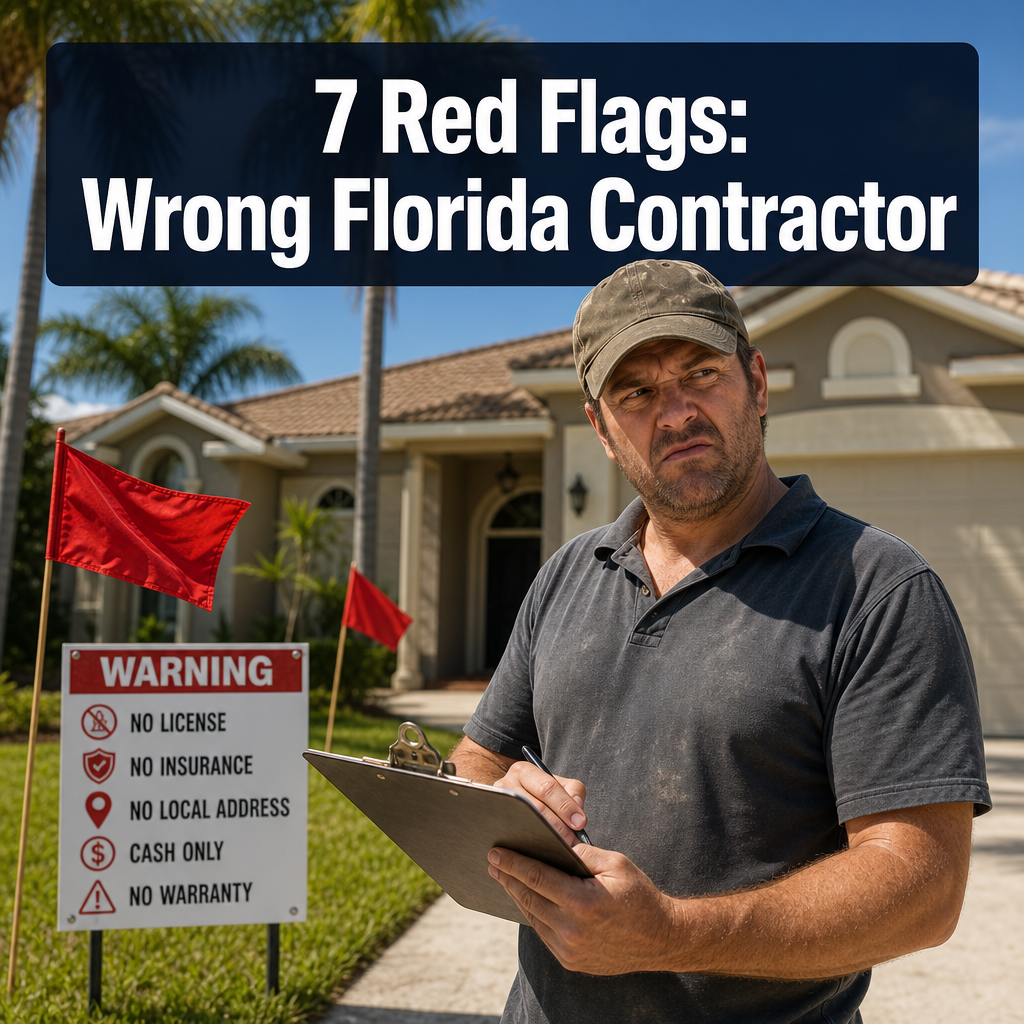
Quick Answer: The 7 red flags that signal you're about to hire the wrong Florida contractor are: no verifiable state license, demands for large cash deposits upfront, no local physical address, pressure to skip permits, vague or verbal-only contracts, no proof of liability and workers' comp insurance, and pricing that's suspiciously far below every other quote. Any one of these should pause the conversation. Two or more should end it.
Key Takeaways
- Florida requires most contractors to hold a state-issued license — verifiable for free through the Department of Business and Professional Regulation (DBPR).
- Unlicensed contractor work can void your homeowner's insurance and create personal liability if a worker is injured on your property.
- A quote that's 30–40% below the market average in Tampa, Miami, or Orlando isn't a deal — it's a data point worth investigating.
- Permit-skipping is one of the most common contractor shortcuts in Florida and can trigger costly code violations when you sell.
- Verbal agreements are unenforceable in most Florida contractor disputes — always get a written, itemized contract.
- Florida's hurricane season (June through November) creates a surge in storm-chaser contractors — unlicensed out-of-state crews who disappear after taking your deposit.
- Verifying a contractor takes less than five minutes using Florida's free DBPR lookup tool.
What's in This Guide:
- Why Florida's Contractor Landscape Is Different From Every Other State
- The 7 Red Flags That You're About to Hire the Wrong Florida Contractor
- What These Red Flags Cost Florida Homeowners by City
- What Florida Insurance Carriers Actually Expect From Your Contractor
- How to Verify a Florida Contractor in Under 5 Minutes
- When to Hire: Florida's Seasonal Calendar for Home Services
- Frequently Asked Questions
- How to Find Verified Florida Contractors Through FL Services Hub
Knowing these red flags before you sign anything is the difference between a smooth renovation and a five-figure nightmare. Start here.
Why Florida's Contractor Landscape Is Different From Every Other State {#florida-context}
Florida is one of the most contractor-regulated states in the country — and also one of the most contractor-fraud-prone. That's not a contradiction. It's the result of a specific combination of factors that exist nowhere else in the Sunshine State.
The insurance pressure is unlike anywhere else. After back-to-back hurricane seasons hammered South Florida, insurers tightened underwriting standards dramatically. Work done without permits, by unlicensed contractors, or without proper documentation can now trigger policy cancellations or claim denials — not just in Miami-Dade and Broward, but increasingly in Sarasota, Fort Myers, and even Orlando.
Storm chasers are a real and recurring problem. After every named storm, out-of-state crews flood into Tampa, Jacksonville, and Naples offering fast, cheap repairs. Many are unlicensed. Many collect deposits and disappear. The Florida Attorney General's office has prosecuted dozens of these cases, but prosecution doesn't recover your $8,000 deposit.
Florida's building codes are stricter than most people realize. The Florida Building Code — updated regularly and enforced at the county level — governs everything from roofing nail patterns to hurricane strapping on HVAC equipment. A contractor who doesn't know Broward County's specific requirements isn't just cutting corners; they're creating code violations that show up in your inspection report when you try to sell.
The labor market is tight year-round. Florida's population growth means demand for skilled tradespeople consistently outpaces supply. That pressure creates space for unqualified operators to fill the gap — especially in fast-growing metros like St. Petersburg, Cape Coral, and Kissimmee.
Understanding this environment is the foundation for spotting the 7 red flags that you're about to hire the wrong Florida contractor. The warning signs aren't random — they're predictable patterns that show up in specific ways in this specific market.
The 7 Red Flags That You're About to Hire the Wrong Florida Contractor {#seven-red-flags}
Each of these red flags, on its own, warrants a direct conversation. More than two together, and you should walk away.
🚩 Red Flag #1: No Verifiable Florida State License
Florida law requires most contractors — roofing, electrical, plumbing, HVAC, general contracting — to hold a state-issued license through the Department of Business and Professional Regulation. A contractor who can't give you their license number on the spot is either unlicensed or hoping you won't check.
Verify any license for free at myfloridalicense.com. Takes three minutes. A valid license shows the contractor's name, license type, expiration date, and any disciplinary history.
What to ask: "What's your state license number?" If they hesitate, deflect, or give you a county-only registration number, that's your answer.
🚩 Red Flag #2: Large Upfront Cash Deposit Required
Legitimate Florida contractors typically require a deposit of 10–30% upfront for materials on larger jobs. A demand for 50% or more — especially in cash — is a pattern associated with contractors who intend to disappear or who are operating without enough capital to purchase materials themselves.
Cash payments also eliminate your ability to dispute a charge through your credit card company. That's not an accident.
The rule: Pay deposits by check or credit card. Never wire money to a contractor you haven't worked with before.
🚩 Red Flag #3: No Local Physical Address
A legitimate contractor operating in Tampa or Fort Lauderdale has a verifiable business address — not just a P.O. box or a cell number. If their "office" is a Google Voice number and a Gmail account, you have no recourse when something goes wrong.
Check their address on Google Maps. Look for a real location. If the address doesn't exist or maps to a UPS Store, that's a red flag.
🚩 Red Flag #4: Pressure to Skip Permits
Permits exist to protect you — not the contractor. When a contractor suggests skipping a permit to "save time" or "keep costs down," what they're actually doing is protecting themselves from inspection while shifting all the risk to you.
Unpermitted work in Florida can:
- Trigger fines from your county building department
- Void your homeowner's insurance claim related to that work
- Require you to tear out and redo the work before a home sale
- Create personal liability if the work causes injury
In Miami-Dade and Broward especially, unpermitted roofing work has resulted in insurance cancellations. Don't let a contractor talk you into saving a few hundred dollars on a permit that protects thousands in coverage.
🚩 Red Flag #5: Verbal-Only or Vague Written Contract
A contract that says "roof repair — $4,500" is not a contract. A real contractor agreement specifies materials (brand, grade, quantity), labor scope, start and completion dates, payment schedule, warranty terms, and what happens if there are change orders.
If a contractor resists putting specifics in writing, that resistance tells you exactly what you need to know about how they'll handle disputes later.
Minimum contract requirements for Florida home service work:
- Contractor's name, license number, and insurance info
- Itemized scope of work
- Material specifications
- Payment schedule tied to milestones
- Warranty terms in writing
- Dispute resolution clause
🚩 Red Flag #6: No Proof of Liability and Workers' Compensation Insurance
If an uninsured worker falls off your roof in Orlando or cuts a gas line in Naples, you may be personally liable for medical bills, property damage, and legal fees. Florida law requires most contractors with employees to carry workers' compensation insurance.
Ask for a Certificate of Insurance before any work begins — not a verbal assurance. Call the insurance company directly to confirm the policy is active. Certificates can be forged; a phone call cannot.
For licensed and insured roofing contractors in Florida, this verification step is non-negotiable given the liability exposure involved.
🚩 Red Flag #7: A Quote That's Dramatically Below Every Other Bid
A quote 30–40% below the market rate in your Florida city isn't a deal — it's a question. Either the contractor is planning to use inferior materials, cut scope mid-project, or add change orders once work has started and you're committed.
Get three quotes. If one is dramatically lower, ask specifically what's different. Sometimes there's a legitimate explanation. More often, the low bid reflects what the contractor plans to actually deliver.
What These Red Flags Cost Florida Homeowners by City {#cost-breakdown}
The financial damage from hiring the wrong contractor varies by project type and city. These ranges reflect the estimated cost of remediation — redoing work, paying fines, or covering uninsured damage — based on common contractor dispute patterns in Florida.
| City | Unpermitted Roof Repair (Redo Cost) | Unlicensed Electrical (Fine + Redo) | Deposit Lost to No-Show Contractor |
|---|---|---|---|
| Miami / Fort Lauderdale | $8,000 – $22,000 | $2,500 – $8,000 | $1,500 – $6,000 |
| Tampa / St. Petersburg | $6,500 – $18,000 | $2,000 – $6,500 | $1,000 – $5,000 |
| Orlando / Kissimmee | $5,500 – $16,000 | $1,800 – $5,500 | $800 – $4,000 |
| Jacksonville | $5,000 – $14,000 | $1,500 – $5,000 | $700 – $3,500 |
| Naples / Sarasota | $7,000 – $20,000 | $2,200 – $7,000 | $1,200 – $5,500 |
Note: These are estimated remediation cost ranges based on contractor dispute patterns and Florida building code violation data. Actual costs depend on project scope, county, and contractor.
The pattern is consistent across Florida: the short-term savings from a low-bid or unverified contractor almost always cost more than the difference when something goes wrong.
Want to compare prices for home services in your city? Get 3 free quotes from verified Florida contractors — no obligation, takes about 60 seconds.
What Florida Insurance Carriers Actually Expect From Your Contractor {#insurance-requirements}
Florida's property insurance market is one of the most scrutinized in the country. After years of litigation and storm losses, carriers have become specific about what contractor work they'll cover — and what they won't.
Permits are now a hard requirement for many claims. If you file a roof claim after a hurricane and your previous roof repair was unpermitted, your carrier may deny the claim or reduce the payout. This applies in Miami-Dade, Broward, Palm Beach, Hillsborough, and increasingly in Pinellas and Collier counties.
Contractor license verification protects your coverage. Some Florida homeowner policies include language requiring that covered repairs be performed by licensed contractors. Work done by an unlicensed contractor — even if the work itself is fine — can create a coverage gap you won't discover until you file a claim.
Workers' comp matters for your personal liability. Florida's workers' compensation laws are specific: if a contractor's employee is injured on your property and the contractor doesn't carry workers' comp, you can be held liable as the "statutory employer." This isn't a theoretical risk — it's an active area of Florida litigation.
What to document before any major project:
- Copy of contractor's state license
- Certificate of Insurance (liability + workers' comp)
- Permit number once pulled
- Signed, itemized contract
- Photo record of work in progress
For licensed plumbing services in Florida or certified electrical work, keeping this documentation in a home improvement file protects you at renewal, at sale, and at claim time.
How to Verify a Florida Contractor in Under 5 Minutes {#verify-contractor}
Verification is faster than most homeowners expect. Here's the exact process:
Step 1: Get the license number. Ask the contractor directly. Any legitimate pro will give it to you without hesitation.
Step 2: Go to myfloridalicense.com. Use the "Verify a License" tool. Search by name or license number. Confirm the license type matches the work being done (a painting license doesn't cover electrical).
Step 3: Check for complaints or disciplinary actions. The DBPR database shows active complaints, past violations, and license suspensions. A single complaint isn't necessarily disqualifying — a pattern is.
Step 4: Verify insurance independently. Ask for a Certificate of Insurance and call the issuing agency to confirm the policy is current.
Step 5: Check Google, BBB, and local reviews. Look for reviews that mention specific projects, specific cities, and specific outcomes — not generic five-star praise. Reviews that mention Sarasota or Jacksonville by name carry more weight than anonymous national reviews.
For HVAC services in South Florida, this verification step is especially important given the complexity of Florida's hurricane-strapping requirements for outdoor units.
When to Hire: Florida's Seasonal Calendar for Home Services {#seasonal-calendar}
Timing your contractor hire in Florida isn't just about convenience — it affects price, availability, and risk.
January – March (Dry Season)
The best time to schedule roofing, exterior painting, and landscaping projects. Contractors are available, weather is cooperative, and you're ahead of the summer storm season. Prices are typically at or slightly below peak.
April – May (Pre-Season Window)
The last window before summer heat and humidity make exterior work uncomfortable and potentially problematic. Schedule HVAC maintenance now — before the June surge when HVAC companies are flooded with emergency calls.
June – September (Hurricane Season Peak)
Demand spikes. Prices follow. Availability of reputable contractors tightens. This is also when storm-chaser contractors appear after named storms. Be especially vigilant about the 7 red flags during this window — the pressure to act fast after storm damage is exactly when bad actors operate.
October – November (Post-Season)
Good time for interior projects — flooring, painting, kitchen updates. Exterior contractors begin freeing up as storm season winds down.
December
Slowest month for most trades. Good leverage for negotiating price on non-urgent projects. Reputable contractors are often more available and more willing to schedule your job promptly.
For a detailed look at what lawn care and landscaping should cost across Florida's seasons, the 2026 Florida lawn care pricing guide breaks it down by region and service type.
Frequently Asked Questions {#faq}
Q: How do I check if a Florida contractor is licensed?
Go to myfloridalicense.com and use the free "Verify a License" search tool. Enter the contractor's name or license number. The results show license type, expiration date, and any disciplinary history. This takes about three minutes and is the single most important verification step before hiring any Florida contractor.
Q: What's a reasonable deposit for a Florida contractor?
Most legitimate Florida contractors request 10–30% upfront for materials on larger projects. Anything above 50% — especially in cash — is a red flag. Always pay by check or credit card so you have a paper trail and dispute options if the contractor fails to perform.
Q: Can I hire an unlicensed contractor for small jobs in Florida?
Florida law allows homeowners to hire unlicensed contractors for certain minor repairs — but "minor" is narrowly defined and varies by county. For anything structural, electrical, plumbing, roofing, or HVAC-related, a state license is legally required. Work done without a license can void insurance coverage and create code violations.
Q: What happens if a contractor skips the permit in Florida?
Unpermitted work can result in county fines, a stop-work order, required demolition and redo of the work, and complications at home sale (title companies and buyers' inspectors will find it). In some cases, it can also affect your homeowner's insurance coverage for claims related to that work.
Q: How do I know if a contractor's insurance is real?
Ask for a Certificate of Insurance listing your name as the certificate holder. Then call the issuing insurance agency — not the contractor — to confirm the policy is active and covers the type of work being done. Certificates can be forged; a direct call to the insurer cannot be faked.
Q: Why are some Florida contractor quotes so much lower than others?
A quote 30–40% below competitors typically reflects one of three things: inferior materials, a plan to add change orders once work starts, or an unlicensed operator with lower overhead because they're skipping insurance and permits. Always ask what's specifically different about a low bid before accepting it.
Q: What should a Florida contractor contract include?
At minimum: the contractor's name, state license number, and insurance information; an itemized scope of work; material specifications by brand and grade; a payment schedule tied to project milestones; warranty terms in writing; and a dispute resolution clause. A contract that says only "roof repair — $X" is not adequate protection.
Q: Are storm-chaser contractors after hurricanes always unlicensed?
Not always — but the risk is significantly higher. After named storms hit areas like Tampa Bay or Southwest Florida, out-of-state crews arrive quickly, often operating without Florida licenses. Always verify the license number through DBPR before signing anything, regardless of how urgent the repair feels.
How to Find Verified Florida Contractors Through FL Services Hub {#find-verified-pros}
The 7 red flags that you're about to hire the wrong Florida contractor are easier to avoid when you start with a pool of contractors who've already been screened.
FL Services Hub is a Florida-focused directory of verified home service professionals across Tampa, Miami, Orlando, Jacksonville, Fort Lauderdale, Naples, Sarasota, and St. Petersburg. Every listing in the directory is manually reviewed — not auto-populated from a national database.
What verification means on FL Services Hub:
- State license confirmed through DBPR
- Insurance documentation on file
- Local service area verified
- Business address confirmed
- Real reviews from Florida homeowners
The directory covers roofing, HVAC, plumbing, electrical, landscaping, pest control, and more — all Florida-local, all verified.
Starting with verified pros doesn't eliminate the need to ask good questions. But it dramatically narrows the field to contractors who've already cleared the baseline checks that most homeowners don't know to run.
Get free quotes from verified Florida contractors in your city →
No obligation. No spam. Just three quotes from real Florida pros who've been checked before they ever appear in your results.
Conclusion: Don't Let a Fast-Talking Contractor Cost You a Slow Recovery
The 7 red flags covered in this guide aren't obscure or hard to spot. They're patterns that repeat — in Tampa after tropical storms, in Orlando during renovation booms, in Naples when snowbirds arrive and demand spikes. The contractors who exploit them count on homeowners being too busy, too trusting, or too eager to get a project done to slow down and check.
Your action steps, right now:
- Before your next call: Bookmark myfloridalicense.com on your phone.
- Before any quote: Ask for the contractor's state license number and verify it before the conversation goes further.
- Before signing: Get a written, itemized contract — not a verbal agreement or a one-line estimate.
- Before any deposit: Confirm insurance with a direct call to the insurer, not just a certificate.
- Before you decide: Get at least three quotes from verified Florida pros so you have a real baseline.
The homeowners who get burned aren't naive — they're rushed. Taking 20 minutes to verify before you commit is the most valuable 20 minutes in any home improvement project.
Find verified Florida contractors in your area →
References
- Florida Department of Business and Professional Regulation (DBPR). Contractor Licensing. https://www.myfloridalicense.com (Accessed 2024)
- Florida Attorney General's Office. Consumer Protection: Contractor Fraud. https://www.myfloridalegal.com (Accessed 2024)
- Florida Building Commission. Florida Building Code, 8th Edition. https://floridabuilding.org (2023)
- National Insurance Crime Bureau. Storm Chaser Contractor Fraud Patterns. https://www.nicb.org (2023)
Tags: Florida contractor red flags, hiring contractors Florida, unlicensed contractors Florida, Florida home improvement, contractor fraud Florida, DBPR license verification, Florida building permits, hurricane season contractors, Tampa contractor tips, Florida homeowner advice, verified Florida pros, home services Florida
Meta Title: 7 Red Flags: Hiring the Wrong Florida Contractor
Meta Description: Spot the warning signs before you sign. These 7 red flags reveal when a Florida contractor is about to cost you thousands — and how to verify before you commit.
<script type="application/ld+json">
{
  "@context": "https://schema.org",
  "@type": "FAQPage",
  "mainEntity": [
    {
      "@type": "Question",
      "name": "How do I check if a Florida contractor is licensed?",
      "acceptedAnswer": {
        "@type": "Answer",
        "text": "Go to myfloridalicense.com and use the free 'Verify a License' search tool. Enter the contractor's name or license number. The results show license type, expiration date, and any disciplinary history. This takes about three minutes and is the single most important verification step before hiring any Florida contractor."
      }
    },
    {
      "@type": "Question",
      "name": "What's a reasonable deposit for a Florida contractor?",
      "acceptedAnswer": {
        "@type": "Answer",
        "text": "Most legitimate Florida contractors request 10–30% upfront for materials on larger projects. Anything above 50% — especially in cash — is a red flag. Always pay by check or credit card so you have a paper trail and dispute options if the contractor fails to perform."
      }
    },
    {
      "@type": "Question",
      "name": "Can I hire an unlicensed contractor for small jobs in Florida?",
      "acceptedAnswer": {
        "@type": "Answer",
        "text": "Florida law allows homeowners to hire unlicensed contractors for certain minor repairs — but 'minor' is narrowly defined and varies by county. For anything structural, electrical, plumbing, roofing, or HVAC-related, a state license is legally required. Work done without a license can void insurance coverage and create code violations."
      }
    },
    {
      "@type": "Question",
      "name": "What happens if a contractor skips the permit in Florida?",
      "acceptedAnswer": {
        "@type": "Answer",
        "text": "Unpermitted work can result in county fines, a stop-work order, required demolition and redo of the work, and complications at home sale. In some cases, it can also affect your homeowner's insurance coverage for claims related to that work."
      }
    },
    {
      "@type": "Question",
      "name": "How do I know if a contractor's insurance is real?",
      "acceptedAnswer": {
        "@type": "Answer",
        "text": "Ask for a Certificate of Insurance listing your name as the certificate holder. Then call the issuing insurance agency — not the contractor — to confirm the policy is active and covers the type of work being done. Certificates can be forged; a direct call to the insurer cannot be faked."
      }
    },
    {
      "@type": "Question",
      "name": "Why are some Florida contractor quotes so much lower than others?",
      "acceptedAnswer": {
        "@type": "Answer",
        "text": "A quote 30–40% below competitors typically reflects one of three things: inferior materials, a plan to add change orders once work starts, or an unlicensed operator with lower overhead because they're skipping insurance and permits. Always ask what's specifically different about a low bid before accepting it."
      }
    },
    {
      "@type": "Question",
      "name": "What should a Florida contractor contract include?",
      "acceptedAnswer": {
        "@type": "Answer",
        "text": "At minimum: the contractor's name, state license number, and insurance information; an itemized scope of work; material specifications by brand and grade; a payment schedule tied to project milestones; warranty terms in writing; and a dispute resolution clause. A contract that says only 'roof repair — $X' is not adequate protection."
      }
    },
    {
      "@type": "Question",
      "name": "Are storm-chaser contractors after hurricanes always unlicensed?",
      "acceptedAnswer": {
        "@type": "Answer",
        "text": "Not always — but the risk is significantly higher. After named storms hit areas like Tampa Bay or Southwest Florida, out-of-state crews arrive quickly, often operating without Florida licenses. Always verify the license number through DBPR before signing anything, regardless of how urgent the repair feels."
      }
    }
  ]
}
</script>